

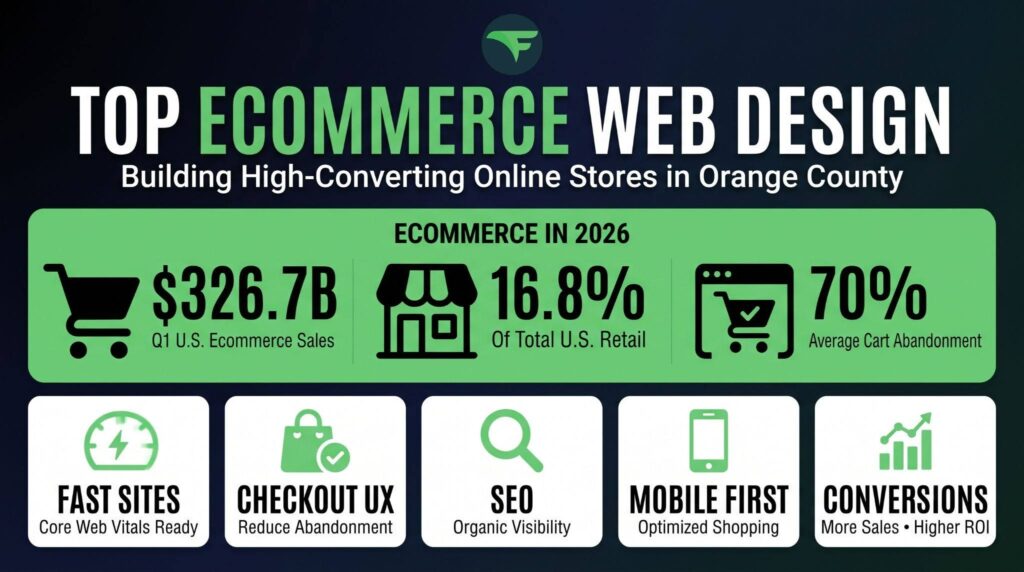
US retail ecommerce sales reached $326.7 billion in Q1 2026 alone, up 9.7% from Q1 2025, according to the US Census Bureau’s Q1 2026 Quarterly Retail E-Commerce Sales report. Ecommerce now accounts for 16.8% of all US retail. Orange County, with its $351.75 billion economy and 1.7 million nonfarm jobs, sits at the centre of that growth. Businesses in the region are not choosing whether to sell online. They are choosing how well they do it.
The firms below build ecommerce websites that convert. Flying V Group is an Orange County-based full-service digital marketing agency. Tell us about your ecommerce project.
What Separates a High-Converting Ecommerce Site from an Expensive One
Checkout Abandonment Is the Primary Revenue Leak
The Baymard Institute’s September 2025 meta-analysis aggregated 50 published studies on shopping cart abandonment. The average abandonment rate is 70.22%. For every ten customers who reach a cart, seven leave without purchasing. That is not a traffic problem. It is a design and UX problem.
The most cited reasons include complicated checkout processes, unexpected costs, forced account creation, and slow page loads. Each of these is a design decision. A well-built ecommerce site reduces friction at the cart stage with single-page checkout, guest checkout options, transparent shipping costs, and mobile-optimised forms. These are not advanced features — they are baseline requirements for a site that converts.
Core Web Vitals Directly Affect Ecommerce Revenue
Google’s Core Web Vitals set three performance thresholds: Largest Contentful Paint under 2.5 seconds, Interaction to Next Paint under 200 milliseconds, and Cumulative Layout Shift under 0.1. Google’s own business impact research documents that fixing Core Web Vitals contributed to 80-100% mobile conversion rate improvement across documented case studies.
For ecommerce, this is not an abstract SEO consideration. A product page that takes four seconds to load on mobile loses a measurable share of potential buyers before they see the product. Orange County ecommerce businesses competing in categories like apparel, home goods, health and beauty, and food and beverage — all high-growth categories per US ecommerce category data — cannot afford to cede that conversion gap.
Top 5 Ecommerce Web Design Firms in Orange County
1. Flying V Group
Best for: Orange County ecommerce businesses that need web design, SEO, and GEO working as a unified revenue system
Flying V Group is a full-service digital marketing and advertising agency founded in 2016, headquartered in Newport Beach, California. We build ecommerce websites that are fast, conversion-ready, and structured for search visibility from the first line of code.
Our builds are built to pass Core Web Vitals on mobile at launch, reduce checkout friction, and integrate cleanly with SEO, GEO, and PPC from day one.
Core Specialties / Community and Track Record
We take ecommerce seriously as a revenue infrastructure problem, not a design project. That means product architecture, crawlable URL structures, mobile-first UX, and downstream marketing integration are part of the build scope, not afterthoughts. See our work for examples across industries.
Ideal client: Orange County ecommerce businesses that want a site built for performance, search visibility, and long-term digital marketing integration from day one.
2. Brandastic
Best for: Orange County ecommerce brands needing custom Magento or WooCommerce development with integrated digital marketing
Brandastic is an Orange County-based digital agency and Certified Magento partner with offices in OC, Austin, and Los Angeles. Their ecommerce practice covers custom Magento and WooCommerce builds, platform migrations, SEO, and PPC — a full-service model suited to Orange County businesses that need ecommerce development and digital marketing managed together. They have been featured in Yahoo Finance and USA Today and serve regional and national brands across retail and B2B categories.
Ideal client: Orange County mid-market and enterprise ecommerce businesses needing custom Magento builds, platform migrations, or complex product catalogue integrations alongside ongoing digital marketing.
3. 500 Designs
Best for: Orange County ecommerce businesses prioritising UX-led design and responsive development
500 Designs is an Irvine-based UI/UX design and web development agency with a consistent record on Clutch, where 100% of reviewers highlight their creativity, attention to detail, and on-time delivery. Their ecommerce work focuses on responsive design, custom website development, and user-focused checkout flows. For Orange County businesses where visual brand presentation and UX quality are the primary differentiators, 500 Designs brings a design-first methodology.
Ideal client: Orange County ecommerce brands and DTC businesses where visual design, UX quality, and on-brand shopping experience are the primary project requirements.
4. GoldenComm
Best for: Orange County B2B and B2C ecommerce businesses needing a full-service agency with deep technical capabilities
GoldenComm is a Newport Beach-based full-service digital agency founded in 1996 with a team of 55 employees. Their ecommerce and web development practice covers B2B and B2C projects across custom development, PPC, and digital strategy. Their longevity in the Orange County market and team depth make them a practical choice for businesses with complex integrations, multi-channel selling, or long-term agency relationship requirements.
Ideal client: Orange County businesses with technically complex ecommerce requirements including ERP integrations, multi-channel inventory management, or B2B portal builds.
5. Imagine Monkey
Best for: Orange County small and mid-sized ecommerce businesses needing custom WooCommerce development with transparent pricing
Imagine Monkey is a Costa Mesa-based WordPress and WooCommerce agency serving Orange County businesses since 2011. Their ecommerce builds combine custom WooCommerce development, API integrations, and performance optimisation without the template-based shortcuts that produce slow, hard-to-maintain sites. Published transparent pricing and a track record in OC SMB ecommerce make them a practical option for businesses that want senior-level development without enterprise pricing.
Ideal client: Orange County small and mid-sized businesses building or relaunching ecommerce on WooCommerce with custom functionality requirements.
How to Choose an Ecommerce Web Design Firm in Orange County
Platform Selection Matters Before Agency Selection
The platform an agency builds on determines long-term flexibility, cost, and capability. WooCommerce suits businesses needing maximum flexibility and WordPress integration. Shopify suits businesses prioritising ease of management over customisation. Magento suits enterprise catalogues with complex pricing and integration requirements. The right agency should help you choose the platform before they propose a build — not default to whichever platform they prefer.
Evaluate by Conversion Metrics, Not Aesthetics
A visually impressive ecommerce site that does not convert is an expensive liability. Before engaging any Orange County ecommerce web design firm, ask:
- What is the average mobile Core Web Vitals score you achieve at launch?
- How do you approach checkout flow and abandonment reduction?
- Can you show documented conversion rate improvements from previous builds?
- How is the site structured for organic search visibility from launch?
- What platform do you recommend for my specific catalogue size and complexity?
Agencies that cannot answer these with specifics are optimising for visual presentation rather than revenue performance.
Build an Ecommerce Site That Earns Its Place in Orange County’s Market
Orange County’s ecommerce market is competitive, and a site that simply exists is not enough. The businesses pulling ahead are the ones with fast, conversion-ready stores that rank organically and perform on paid channels simultaneously. If that is the kind of site you need, contact Flying V Group and let’s build it.
Frequently Asked Questions
What does an ecommerce web design firm in Orange County do?
An ecommerce web design firm builds and optimises online stores for Orange County businesses, covering platform selection, UX and UI design, product catalogue architecture, checkout flow optimisation, performance tuning for Core Web Vitals, and SEO structure. The best firms connect ecommerce design directly to revenue metrics rather than delivering a visually polished site that underperforms on conversion and search visibility.
How much does ecommerce web design cost in Orange County?
Orange County ecommerce web design pricing ranges from approximately $5,000 to $15,000 for mid-market custom builds, $15,000 to $50,000 for sites with complex backend integrations or large product catalogues, and $50,000-plus for enterprise builds with ERP or multi-channel integrations. The investment is largely determined by catalogue complexity, custom functionality requirements, platform choice, and whether ongoing digital marketing is included in the scope.
Which ecommerce platform is best for Orange County businesses?
Platform choice depends on business complexity. WooCommerce suits businesses already on WordPress that need maximum customisation and cost control. Shopify suits businesses prioritising ease of management and a hosted infrastructure. Magento suits enterprise ecommerce with complex pricing rules, B2B portals, or large catalogue requirements. The right agency helps select the platform before the build, not after.
Why is cart abandonment so important for ecommerce design?
The Baymard Institute’s 2025 meta-analysis of 50 studies found an average cart abandonment rate of 70.22%. Seven out of ten shoppers who reach the cart leave without purchasing. Most abandonment is driven by checkout friction — complicated processes, unexpected costs, forced account creation, and slow page loads. These are design and performance problems that a well-built ecommerce site addresses at the architecture level.
How does Core Web Vitals performance affect ecommerce sales?
Google’s Core Web Vitals are ranking signals and direct conversion drivers. A product page that fails LCP benchmarks on mobile loads too slowly for a meaningful share of mobile shoppers who abandon before the product renders. Google’s own case study research documents 80-100% mobile conversion rate improvements following Core Web Vitals fixes. For Orange County ecommerce businesses competing in high-intent search categories, Core Web Vitals performance is a revenue variable.
How does an ecommerce site rank in Google Search?
Ecommerce SEO covers product page architecture, crawlable URL structures, structured data for products and reviews, internal linking between category and product pages, Core Web Vitals performance, and content that targets commercial and transactional search queries. US ecommerce now accounts for 16.8% of all US retail per Census Bureau data. Organic search visibility determines what share of that demand a business captures without paying per click.
How long does an ecommerce web design project take in Orange County?
A standard mid-market ecommerce build with 50 to 200 products typically takes six to ten weeks from discovery to launch. Complex builds with custom integrations, large catalogues, or multi-stakeholder approval processes typically run twelve to twenty weeks. Timeline is most directly affected by content readiness, product data quality, and the complexity of third-party integrations required at launch.