Industry: Debt Defense Litigation
Practice Area: Consumer debt defense, debt collection harassment, and credit dispute representation
Engagement Length: ~26 months (Early 2024 through March 2026)
The Challenge: Intercepting the Quiet Panic of Debt Collection
Debt collection defense is one of the most emotionally charged, high-stress corners of legal practice. An aggressive collection letter or court summons triggers immediate panic, and at the moment people don’t research abstract legal frameworks. Instead, they type the frightening name on the letterhead straight into Google and hunt for a lifeline.
In early 2024, our client, a national debt defense law firm, was invisible to these consumers. Strong litigation capabilities meant nothing if prospective clients couldn’t find the firm.
Three problems stood in our client’s way:
- Negligible organic visibility: The website drew 833 organic visits per month. Although it ranked for 1,091 keywords, only 101 sat on page one, and most of them clustered near the bottom. The other 90% sat on page three and beyond. Alongside our SEO experts, our job is to consolidate and make your website work for you by attracting business, rather than the other way around.
- Branded keyword over-reliance: Nearly all organic traffic came from users who already knew the firm’s name. Non-branded searches targeting specific collection agencies and creditors, which drive high-intent acquisition in this niche, went undeveloped. Word of mouth is a great way of doing business, but in a world where the digital marketplace is rapidly changing and expanding, it is important to outsource for clients and increase outreach efforts.
- Thin content and low authority: A Domain Rating of 6 and 57 referring domains gave the site no authority with search engines. Practice area pages ran text-thin and technical, with no case studies or educational guides to build consumer confidence. The firm was a ghost town except for the exact terms prospective clients searched during personal financial crises. The project called for a ground-up authority build.
The Strategy: Turning Moments of Crisis Into Pathways for Defense
Before starting content work, we opened with a technical audit where we cleared crawl errors, duplicate-content systems, broken links, and site speed bottlenecks. From there, we ran a four-track campaign rooted in how frightened consumers actually search.
Track 1: Credibility and Trust — Earning Confidence in the Search Results
We added LocalBusiness, Attorney, and Review schema across the site architecture. This directly communicated search engines the firm’s real-world credentials, so Google could surface five-star reviews and location signals on the results page. Consumers got visual reassurance before they clicked.
Track 2: Intercepting the Moment of Panic – Arming Clients with Knowledge
Rather than fighting for saturated head terms like “debt relief,” we targeted the precise behavioral point of need. We published reassuring, in-depth guides answering “what to do if you receive a letter from [collection agency name],” optimized for the top agencies our client’s prospects face.
Track 3: Increasing Approachability – Simplifying Complex Legalese
Stripping dense jargon from practice pages and FAQs, we focused our efforts on rewriting the content to read like an authoritative ally, rather than a daunting information center. We also rebuilt attorney biographies, shifting the focus from school accolades to why these lawyers choose to fight for the underdog.
Track 4: Intent Alignment — Mapping the Right Terms to the Right Pages
Mapping high-intent core terms such as “debt collection lawyer” and “legal debt settlement,” we established pages to remove keyword conflicts. By tightening calls to action, enabling click-to-call, and setting up a review-acquisition, we built a pipeline to grow the company’s trust signals over time.
The Results: Translating Quantitative Growth into Human Impact
Over 26 months, the numbers reflect both technical gains and a real rate expansion of the firm’s reach. All figures come from Ahrefs, tracking the US market from January 2024 through March 2026.
Organic Visibility and Traffic Market Value
| Metric | January 2024 | March 2026 | Net Change
|
|---|---|---|---|
| Monthly Organic Traffic | 833 | 25,585 | +2,971% (~31x Growth) |
| Monthly Organic Traffic Value | $3,411 | $50,869 | +1,391% |
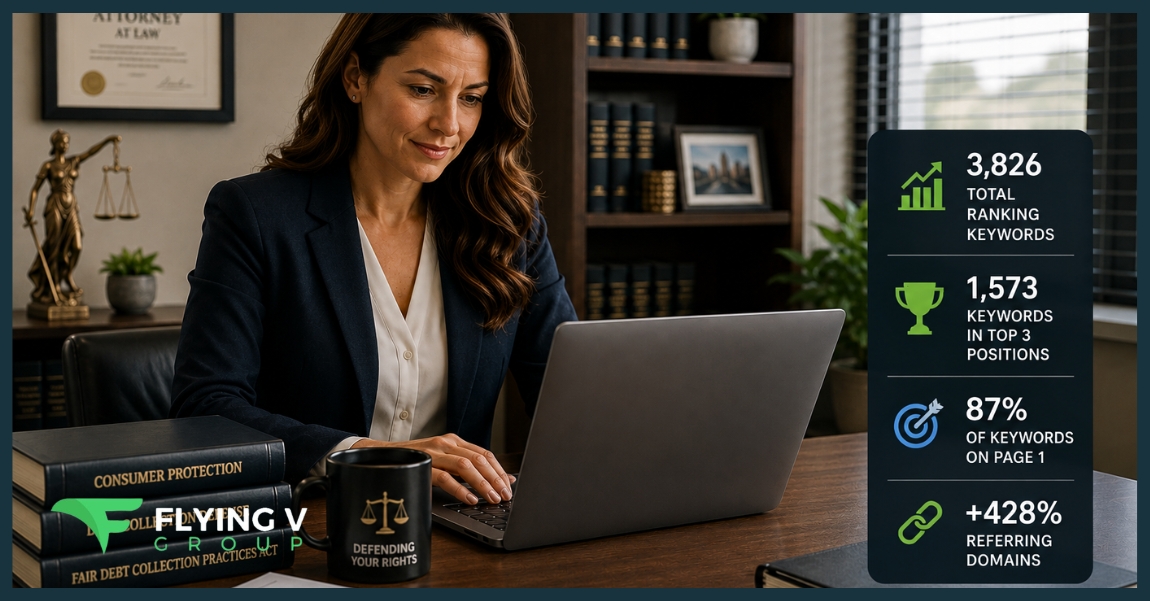
| Total Ranking Keywords | 1,091 | 3,826 | +2,735 (+251%) |
Ranking Quality & Search Footprint Dominance
The placement shift tells the sharper story. Page-one presence grew from a thin baseline into the core of the firm’s digital footprint.
| Position Bucket | January 2024 | March 2026 | Footprint Growth
|
|---|---|---|---|
| Top 3 Positions (Premium Visibility) | 29 | 1,573 | >54x Expansion |
| Positions 4–10 | 72 | 1,773 | +2,362% |
| Total Page 1 Presence | 101 | 3,346 | +3,212% |
By March 2026, roughly 87% of all ranked keywords sat securely on page one (3,346 out of 3,826), compared to less than 9% at the campaign’s inception.
Domain Authority and Efficiency
| Metric | January 2024 | March 2026 | Net Change
|
|---|---|---|---|
| Domain Rating (DR) | 6 | 16 | +10 Points |
| Referring Domains | 57 | 301 | +428% |
What do these numbers mean at a human level? It means that every single month, over 25,500 highly stressed consumers are finding clear, compassionate, authoritative legal reassurance from our client at the exact fraction of a second they need it most.
The authority shift illustrates our central strategic principle: traffic scales via precision intent matching, not backlink volume. With a Domain Rating climbing by a modest 10 points, traffic skyrocketed by more than 3,000%. By skipping broad, high-difficulty terms and focusing on low-competition, high-conversion queries, we engineered a durable and exceptionally cost-efficient lead engine.
Frequently Asked Questions
What happens after contacting a debt defense law firm?
Most firms start with a free or low-cost consultation to review your situation before you commit to anything. You’ll typically walk through the letter or summons you received, the collection agency or creditor involved, and your options, whether that’s disputing the debt, negotiating a settlement, or defending a lawsuit. This first conversation is about understanding where you stand, not signing paperwork on the spot, so it’s worth reaching out even if you’re still unsure.
How does schema markup help a law firm attract clients?
Schema markup lets search engines display trust signals like star ratings, reviews, and location details directly in the results page. For an anxious consumer comparing options, that visual reassurance can earn the click before they’ve even visited the site. In this project, LocalBusiness, Attorney, and Review schema helped surface five-star reviews at the exact point where frightened searchers were deciding whom to trust.
What makes agency-specific keywords more valuable than “debt relief?”
Because that’s where the high-intent traffic actually is. Someone searching “debt relief” is often browsing, but someone searching the exact name on a letter they just received is in a moment of acute need and far closer to hiring a lawyer. These agency-specific queries also carry far less competition than broad head terms, which makes them cheaper to rank for and more likely to convert.
Can a law firm rank on Google with a low Domain Rating?
Yes. Domain Rating measures backlink authority, but it isn’t the only path to rankings. In this engagement, DR rose just 10 points (from 6 to 16) while organic traffic grew more than 3,000%, because the strategy prioritized precise, low-competition, high-intent queries over chasing links. A focused content and intent strategy can outperform raw authority when the target keywords are well chosen.
How long does SEO take to show results for a law firm?
Meaningful movement in a competitive legal niche usually takes 4 to 6 months, with compounding gains beyond that. In this case study, the full engagement transformation ran 26 months, growing monthly organic traffic from 833 to 25,585 visits. Debt defense is less saturated on non-branded, agency-specific terms than broad areas like personal injury, which is part of why the traffic curve climbed so steeply once the content engine was in place.