
Signing with a social media marketing agency in San Diego often feels like the finish line. It is closer to the starting gun. The weeks that follow decide whether you get a working partnership or a monthly invoice attached to a content calendar nobody reads.
Most first-time clients have no reference point for what normal looks like. How much input will the agency need? When do results show up? Who answers the DMs at 9 p.m. on a Saturday?
What follows is a walkthrough of a healthy agency relationship, from onboarding to monthly reporting, plus what should change because your customers are in San Diego. Flying V Group runs this same process for its clients, and the benchmarks apply to any agency you hire.
San Diego’s Economy Should Shape Your Strategy
The San Diego region supported 1.6 million jobs and $266.9 billion in gross regional product in 2024, according to the San Diego Regional EDC. The EDC lists defense, life sciences, software, manufacturing, and tourism among its key industries, and estimates that about 20% of regional GRP traces back to defense-related spending.
Small companies dominate the business base. Small businesses make up 99% of firms in the region but only 59% of regional employment, per the EDC’s 2025 annual report. Most San Diego clients compete with neighbors rather than national brands, so a borrowed national playbook rarely fits.
Industry Mix Changes the Platform Mix
Expect your agency to justify its platform choices by audience and business model. A reasonable starting point often looks like this:
| Business Type | Where Strategy Often Leans |
| Restaurant or hospitality | Instagram, TikTok, creator content, local discovery |
| Tourism or attraction | Visual storytelling, visitor-focused and seasonal campaigns |
| B2B tech or defense contractor | LinkedIn, executive thought leadership, lead generation |
| Life sciences | Educational content, LinkedIn, stricter claim review |
| Home services | Geographic targeting, reviews, before-and-after content |
| Ecommerce | Paid social, creator testing, conversion tracking |
Treat the table as a hypothesis, not a formula. An agency that sells every client the same three-platform package has skipped the research step.
Strategy at the Neighborhood Level
The City of San Diego runs 18 active Business Improvement Districts with more than 11,000 participating small businesses. Their associations promote members through social media, cooperative advertising, and events like the Adams Avenue Street Fair and Hillcrest’s CityFest.
A good agency asks which district, events, and customer radius matter to you. A software firm in Sorrento Valley may need almost no neighborhood targeting, while an Ocean Beach storefront depends on it.
What a Social Media Agency Handles
“Social media management” can cover seven different services: strategy, content creation, publishing, community management, paid social, creator marketing, and analytics. Few retainers include all seven, so confirm in writing which ones yours covers and which cost extra.
At Flying V Group, our social media marketing scopes list each of those pieces as a line item with a monthly deliverable count. Expect that level of detail from any agency, since vague scopes are where most client frustration starts.
What the First 90 Days May Look Like
The timeline below is an example workflow, not an industry rule. Your agency’s version may run faster or slower, but each stage should happen in roughly this order.
| Stage | What to Expect |
| Weeks 1 to 2: Discovery | Goal setting, audience and competitor research, account audit, brand voice, access setup |
| Weeks 2 to 4: Strategy | Platform selection, content pillars, KPIs, paid and organic roles, reporting framework |
| Month 2: Execution | Content calendar, production, approvals, publishing, community management, first paid tests |
| Month 3: Optimization | Winning formats identified, creative adjusted, results compared with the baseline |
| Ongoing | Monthly reports, creative testing, campaign planning, regular check-ins |
What the Agency Needs From You
Expect heavy involvement early: a kickoff interview, brand assets, past performance data, and a named approver. After launch, most clients settle into a weekly approval window and a monthly review. Businesses without an internal marketing lead sometimes add fractional CMO support so someone owns strategy on their side.
How Content Approval and Publishing Work
Every post should pass through an agreed approval path, with a set number of revision rounds and a turnaround time for each. The FTC’s advertising guidance states that ad claims must be truthful, non-deceptive, and evidence-based, so approvals should include checking price, performance, and product claims against proof.
That review carries extra weight in regulated San Diego sectors like life sciences and healthcare. Ask who verifies claims and what happens when a post needs legal sign-off.
Organic and Paid Run on Different Tracks
Organic social builds presence with people who already follow or discover you. Paid social buys distribution to defined audiences and optimizes toward traffic, leads, or sales. Ask who creates ad creative, who owns the ad account, how the media fee is calculated, and whether the landing pages receiving that traffic are built to convert.
Community Management and Creator Campaigns
Publishing is half the job. The other half happens in comments, DMs, and creator partnerships.
Comments, DMs, and Escalation
The contract should spell out response hours, weekend coverage, and escalation rules for complaints or crisis posts. Strong agencies also run social media monitoring beyond your own profiles, catching brand mentions and competitor conversations you would otherwise miss.
Influencer and Creator Work
Creator sourcing is only the first step. Expect briefs, content approvals, disclosure checks, and campaign measurement, all shaped by the FTC’s guidance on endorsements, influencers, and reviews, including the Endorsement Guides revised in 2023.
Account Access and Privacy at Onboarding
Onboarding should never require emailing your master passwords. Expect role-based access through each platform’s business tools, confirmed recovery contacts, and removal of any former agency’s access. The CISA guide to multifactor authentication names social media accounts among the logins MFA should protect.
If the agency will run pixels, retargeting, or custom audiences, privacy belongs in the same conversation. Decide who configures consent tools and tracking, and put it in writing before the first campaign launches.
What Your Monthly Report Should Tell You
A useful report answers four questions: what happened, why it happened, what the team learned, and what changes next month. Thirty-seven charts with no interpretation answer none of them.
Expect results tied to the KPIs set during strategy, plus a clear connection between social activity and web analytics data such as sessions, leads, or revenue. The “what changes next” section matters most, because it shows the agency is steering and not just posting.
What a Reputable Agency Will Not Promise
No legitimate agency guarantees a follower count, a viral post, or a fixed number of leads by a set date. Guarantees like these tend to end in purchased followers or engagement pods, which inflate numbers without producing customers.
Expect forecasts built on your baseline and budget instead, with the assumptions stated. Honest ranges are a better sign than confident promises.
Starting the Relationship on the Right Foot
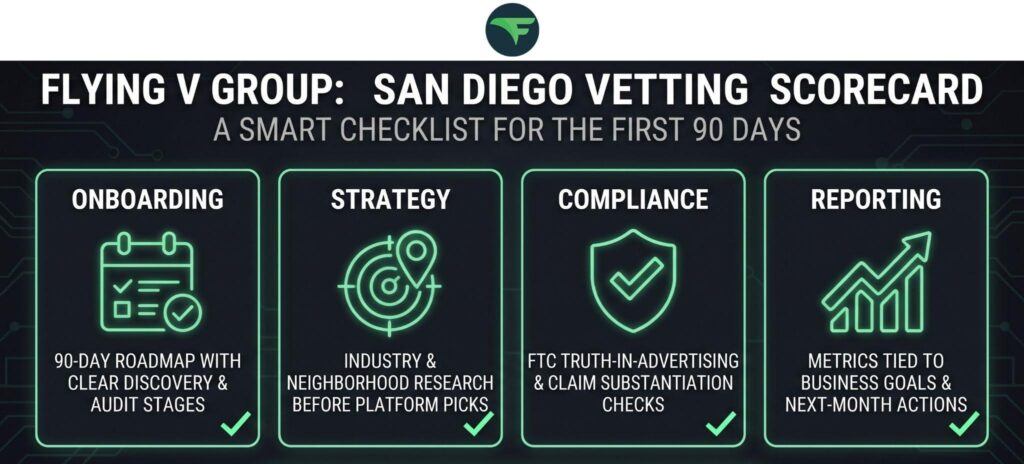
A strong San Diego agency relationship includes a line-item scope, research before platform picks, a defined approval path, secured accounts, and reports that end with next steps. If a proposal is missing any of those pieces, ask for them before you sign.
Flying V Group builds social programs around this onboarding-to-reporting cycle, from neighborhood-level audience research to monthly reports that name what changes next. To see what your first 90 days would look like, start a conversation with our team.
Frequently Asked Questions
Does the CCPA apply to a small San Diego business?
The CCPA applies to for-profit California businesses that meet at least one threshold, such as more than $25 million in annual revenue or buying, selling, or sharing personal information of 100,000 or more California residents or households, according to the California Attorney General. Many small businesses fall below those lines, but high-traffic ecommerce sites running ad pixels should check where they stand.
Can a social media agency post health claims for my clinic or supplement brand?
An agency can publish health claims only when the business can back them with solid proof, a standard the FTC’s health claims guidance stresses for supplements, over-the-counter drugs, and other health products. Expect the agency to request your substantiation before a claim goes live.
How often should new content go live?
No single posting frequency works for every business. Cadence should follow your platforms, production capacity, and audience response, and consistency usually matters more than volume.
Will I need to supply my own photos and videos?
Most agencies combine client-supplied assets with content they shoot or design themselves. Clarify how many shoots are included per quarter and whether raw footage belongs to you.
Can one agency manage several locations across San Diego County?
Multi-location clients typically get a shared brand strategy with location-specific pages, offers, and community replies. Ask how the agency keeps Chula Vista, Escondido, and downtown profiles consistent without making them identical.
How should an agency handle a post that draws negative comments?
A good agency replies publicly once with a calm, factual response and moves the conversation to DMs or email. Deleting legitimate criticism usually backfires, so agree in advance on what gets hidden, answered, or escalated.
Should I sign a 12-month contract with a social media agency?
Longer contracts can lower monthly rates, but they lock you in before you have seen the agency’s work. Many businesses prefer a 90-day initial term with clear exit terms, including how accounts and files get returned.