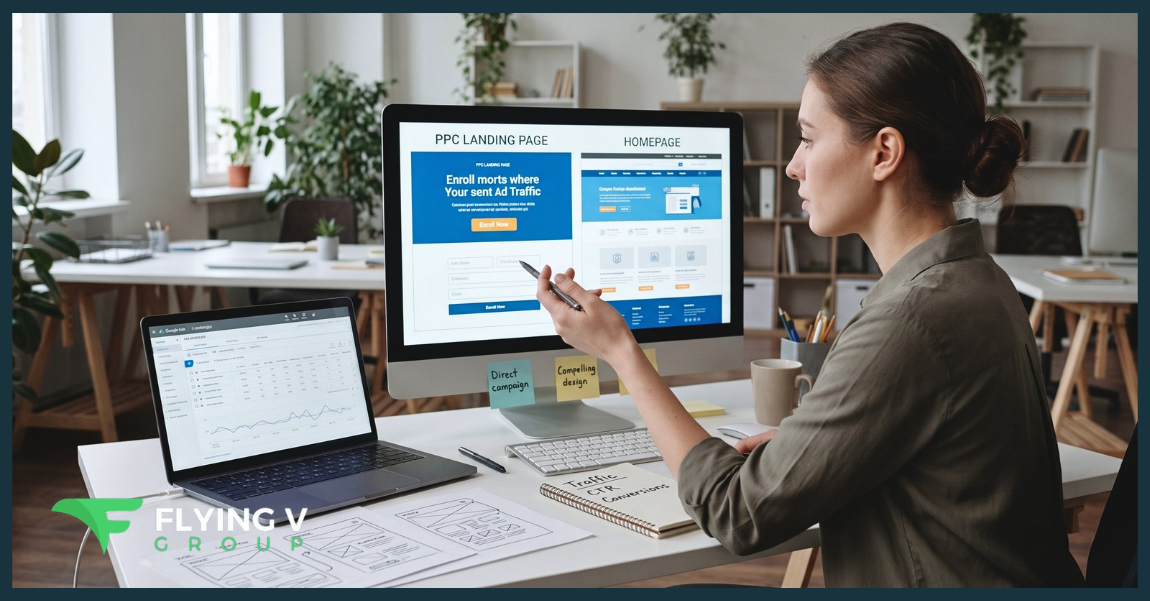
For most high-intent searches, a PPC landing page beats your homepage, but “dedicated landing page” isn’t the only alternative. The right destination is the most specific page that matches the keyword, the ad’s promise, and the action you want next. Sometimes that’s a purpose-built PPC page, often it’s an existing service page, and now and then it’s the homepage.
The better question isn’t “homepage or landing page?” It’s which page leaves the fewest steps between the search and what the searcher came to do.
At Flying V Group, we map each ad group to a destination before launch, so paid clicks don’t land on a page that makes visitors search again. If you’re unsure where your ads should point, have our team review your ad-to-page paths.
Ask a Different Question: How Far Is the Page From the Search?
Every paid click follows a chain: query, ad promise, destination, action. Intent distance is how much work a visitor must do after clicking before reaching what they searched for.
Someone searching “commercial roof replacement Dallas” who lands on a homepage has to click Services, then Commercial, then Roofing, then Replacement, then hunt for Dallas details. A dedicated page puts the service, local proof, and a quote request one scroll apart.
More Specific Searches Need More Specific Destinations
A search for “ABC Plumbing” is navigational, so the homepage fits. “Plumber Los Angeles” points to a Los Angeles plumbing service page, and “water heater repair Los Angeles” to a page for that exact service.
“Emergency water heater repair near me” calls for a focused page with a prominent call button. As intent narrows, the destination should narrow with it.
Three Destinations, Not Two
Paid traffic can go to the homepage, an existing service, product, or location page, or a dedicated PPC landing page. Treating the choice as binary pushes teams to build pages they don’t need, or to settle for a homepage that hides the answer.
When the Homepage Is the Right Destination
The homepage works for branded searches, broad company research, businesses with a single simple offer, and searchers who need to choose among several distinct paths. A visitor searching “Nike” probably wants to pick Men, Women, or Kids before anything else.
Even then, check whether a category page would shorten the path. A search for “commercial insurance company” might be better served by a page listing property, liability, and cyber coverage than by a general homepage.
When an Existing Service Page Is Enough
If your site already has a strong “Irvine Estate Planning Attorney” page with credentials, FAQs, reviews, and a consultation CTA, rebuilding it for PPC creates duplicate content to maintain. Test the existing page first.
Before commissioning anything new, ask whether the page matches the search intent, continues the ad’s message, loads fast, shows proof, and makes the CTA obvious. If it does, it’s a PPC destination already.
When a Dedicated Landing Page Earns Its Build
Build a dedicated page when the campaign needs something your site doesn’t offer: a specific promotion, audience, qualification form, or CTA. An organic “Business Loans” page won’t serve a campaign for “same-day equipment financing for dental practices.”
Group destinations by intent cluster, not by keyword. “Emergency plumber,” “24-hour plumber,” and “urgent plumber” can share one 24/7 emergency page, while “water heater installation” needs its own.
Message Match From Keyword to CTA
Google’s guidance on optimizing ads and landing pages says to choose a landing page that closely matches your ad and keywords. It adds that the page should mirror the ad’s call to action. An ad for “Same-Day AC Repair in San Diego” should land on a page with that headline, not “Comfort Solutions for Every Season.”
The CTA should also match the searcher’s commitment level. “Emergency plumber near me” fits “Call Now,” “enterprise CRM software” fits “Book a Demo,” and “best commercial roofing systems” may need “Compare Options” before a quote request.
The Five-Second Destination Test
Within a few seconds of landing, a visitor should be able to answer five questions:
- Am I in the right place?
- Do they offer exactly what I searched for?
- Do they serve someone like me?
- Is there a reason to trust them?
- What do I do next?
If the page can’t answer these quickly, it isn’t ready for paid traffic, whether it’s a homepage or a purpose-built page.
Why a Dedicated Page Can Still Lose
A landing page with generic copy, no reviews, no company information, and one aggressive form can underperform a homepage packed with case studies, credentials, and clear navigation. Dedicated doesn’t mean good.
High-consideration purchases in legal, finance, B2B, healthcare, and construction often need proof, process details, and pricing context before a visitor converts. Strip those out for focus, and you remove the evidence the buyer needs.
Navigation: Keep Links That Help the Decision
“Never include navigation” is too absolute. Removing menus cuts distraction, but high-trust buyers may want to verify who you are, where you operate, and what results you’ve delivered.
Keep links that help visitors evaluate or complete the purchase, such as reviews, case studies, and credentials. Cut links that pull them into unrelated parts of the site.
Location Pages Need More Than a Swapped City Name
Changing “Los Angeles” to “Newport Beach” in an H1 creates a doorway page, not a better destination. A genuine location page shows services available in that market, relevant industries, the service area, and local proof.
What Landing Pages Do and Don’t Do for Quality and Cost
Landing page experience is one of three Quality Score components, alongside expected CTR and ad relevance. Google’s Quality Score documentation calls the score a diagnostic tool, not an input in the ad auction. Each component is rated against advertisers who appeared for the same exact searches over the last 90 days.
Be wary of promises that a landing page will cut your CPC by a fixed amount, because too many auction factors are in play. Aim for a relevant page, then prove its value through conversion economics.
Judge the Page on Qualified Leads
Suppose a homepage gets 1,000 clicks for $5,000 and produces 50 leads at $100 each. A dedicated page gets 900 clicks for $4,500 and produces 72 leads at $62.50 each. More of the traffic you paid for became leads.
Then go one level deeper. Per 1,000 visitors, a page converting at 12% with 20% qualified yields 24 qualified leads. One converting at 7% with 70% qualified yields 49, so the “weaker” page wins on business outcomes.
Check Mobile Speed First
Google’s guide to evaluating landing page performance notes that in retail, a one-second mobile delay can cut mobile conversions by up to 20%. Its Landing pages report shows a mobile-friendly click rate for every destination you use.
Test tap-to-call, form usability, cookie banners, and popups on a real phone. A strong desktop page with a frustrating mobile form isn’t a good PPC destination.
When Google Picks the Landing Page for You
With AI Max for Search, Final URL expansion is on by default. It lets Google swap your final URL for a more relevant page on your domain, limited to query-relevant URLs themed to the ad group. Performance Max works similarly, which confirms that the right destination can change by searcher.
That flexibility has costs. When expansion picks a different URL, Google stops serving pinned responsive search ad assets. Exclude careers, blog, and support pages, and turn expansion off when one page is the only conversion path.
Homepage vs Existing Page vs Dedicated Page
| Search or ad situation | Best starting destination |
| Brand or company-name search | Homepage |
| Broad category with several paths | Homepage or category page |
| Specific service or product query | Existing service or product page |
| Location plus service | Strong location page or dedicated page |
| Emergency, high-urgency service | Dedicated page with prominent call CTA |
| Campaign-specific offer or promotion | Dedicated landing page |
| High-ticket research query | Detailed service page with proof |
| New offer being tested | Dedicated landing page |
| Existing page already converts well | Keep the existing page |
| Only one valid conversion path | Dedicated page with URL expansion off |
Matching Every Ad to the Right Page
Send paid traffic to the page that most directly completes the searcher’s task. Use the homepage when visitors need it, existing pages when they already answer the intent, and dedicated pages when the campaign needs a different offer, audience, or controlled path.
Flying V Group pairs PPC management with conversion-focused web design, so ad groups and landing pages get built around the same intent clusters. If your ads still point to a generic homepage, talk to our team about mapping better destinations.
Frequently Asked Questions
Why was my Google ad disapproved for “destination mismatch”?
A destination mismatch disapproval happens when the final URL and the page visitors reach resolve to different domains. Google’s landing page testing tool flags redirect chains that leave your final URL’s domain as the cause.
Can I send mobile users to a different landing page than desktop users?
Google Ads supports a separate final mobile URL for visitors on phones. Google’s mobile URL guidance says it works in Search, Display, and Performance Max campaigns, as long as it uses the same domain as the main final URL.
Why does Google Ads say my landing page wasn’t found?
A “page not found” result can come from a broken URL or from your site blocking Google’s ad crawler. Google’s landing page test guidance recommends confirming that robots.txt allows Google AdsBot to crawl the page.
Why does my keyword show a dash instead of a Quality Score?
A dash means there aren’t enough searches that exactly match the keyword to calculate a score. Google’s Quality Score help page suggests broadening match types so the keyword enters more auctions and gathers enough data.
Does the Google Ads Landing pages report include sitelinks?
The Landing pages report includes sitelink URLs for Search campaigns as well as headline URLs. According to Google’s landing page performance guide, sitelink data appears for all served ads starting January 2021.
Can I control which pages AI Max sends traffic to?
You can guide AI Max with URL exclusions, URL inclusions, and page feeds. Google’s Final URL expansion documentation explains that page feeds with custom labels let you target specific URLs at the ad group level.
How many ads should each ad group have when testing a landing page?
Google recommends three to five ads per ad group. Its ad and landing page guidance notes that Google Ads automatically favors the better-performing ads once several are running.