

Social media management for Charleston SC businesses usually starts with one question: how often should we post? No single number works for everyone, and an agency that quotes one before learning your business is selling a package instead of a plan.
A King Street boutique, a Mount Pleasant dental office, and a Daniel Island software company all need different rhythms. Their audiences use different platforms, their busy seasons fall in different months, and their teams can produce very different amounts of good content.
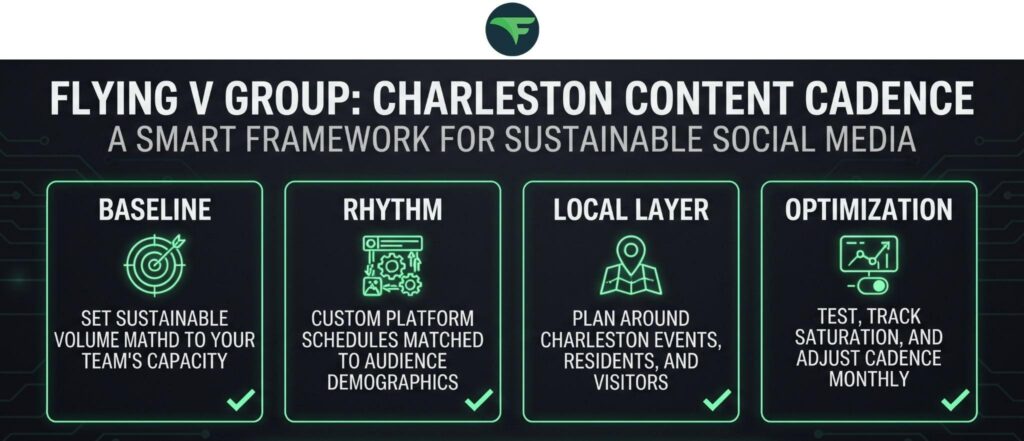
Below is a working framework for setting a cadence you can sustain, test, and adjust, including how Charleston’s event calendar and visitor traffic should shape it. Flying V Group builds client calendars this way, starting from what the data supports rather than a fixed post count.
Charleston by the Numbers
Charleston had an estimated 159,423 residents in July 2025, up 5.8% from its 2020 base, and 92.8% of households have a broadband subscription, according to U.S. Census Bureau QuickFacts. The same data shows $4.89 billion in retail sales and $1.55 billion in accommodation and food service sales in 2022.
Retail sales worked out to $31,797 per resident, which suggests the city’s shops draw heavily on visitors and shoppers from outside city limits. For restaurants, hotels, and retailers, one calendar is often speaking to two audiences at once.
Content Cadence Is More Than Posting Frequency
Posting frequency is only the visible part. A full content cadence also covers when content gets created, when the client approves it, when the team replies to comments and DMs, when it listens for brand mentions, when it reviews performance, and when it reports results. If any of those rhythms breaks, the posting schedule usually breaks with it.
Creator content adds one more rhythm. The FTC’s Endorsement Guides FAQ says there is no one-size-fits-all standard for monitoring influencer posts and suggests pre-approval when regular monitoring is too much. Build that review step into the calendar instead of adding it after posts go live.
How Often Should a Charleston Business Post?
A sustainable cadence is the amount of high-quality content your team can produce consistently, adjusted by platform, audience, and performance data. Start there, then test whether posting more or less changes meaningful results such as profile actions, website visits, or leads.
At Flying V Group, our social media marketing programs set that baseline during onboarding and revisit it monthly. The factors below decide where the baseline lands.
The Factors That Set Your Cadence
| Factor | Question to Ask | How It Changes Cadence |
| Audience | Who are we trying to reach? | Different age groups favor different platforms |
| Content capacity | What can we produce well, every week? | Filler hurts results more than silence |
| Business model | How long is the purchase cycle? | Short cycles support more frequent posts |
| Seasonality | When does demand peak? | Campaign volume rises around real demand |
| Local events | Which Charleston events matter to us? | Adds pre-event, event-day, and recap posts |
| Community activity | Are customers commenting and messaging? | Engagement time counts as cadence too |
Cadence by Business Type
| Business | What Tends to Drive the Calendar |
| Restaurant or bar | Specials, events, guest content, Stories |
| Hotel or attraction | Seasonal planning, destination content, trip-planning windows |
| Retailer | Product drops, promotions, local shopping events |
| Home services | Completed projects, seasonal needs, FAQs |
| Professional services | Fewer, more substantive expertise posts |
These are starting points, not quotas. An accounting firm posting like a restaurant will wear out its team and its audience’s patience.
Why Each Platform Needs Its Own Schedule
Copying one cadence across every channel ignores how differently people use them. Pew Research Center’s 2025 social media survey found that 80% of adults ages 18 to 29 use Instagram, compared with 19% of adults 65 and older, while daily Facebook use peaks among adults 30 to 49 (58%) and 50 to 64 (54%).
Roughly half of adults under 30 use TikTok daily, versus 5% of those 65 and older. A Charleston wedding venue courting engaged couples and a financial planner serving retirees should not share a posting plan, even if both use the same three platforms.
Build a Baseline, Test It, Then Adjust
Treat cadence as a hypothesis you refine, not a setting you pick once.
Start With What You Can Sustain
Commit to the volume your team can deliver without dropping quality. If the business can supply footage for two strong videos a month, schedule two, not eight thin ones. Planning each shoot with video SEO in mind lets one filming session feed social, YouTube, and your website.
Measure by Platform and Watch for Saturation
Track reach per post, saves and shares, video completion, profile actions, website visits, and leads by platform and format. If extra posts keep producing weaker results without lifting total reach or conversions, you have hit saturation, and more volume is not helping.
Adjust Every Month
Shift volume toward the formats and topics that earn results and away from the ones that don’t. A cadence that never changes usually means nobody is reading the data.
When to Post More, and When to Pull Back
Increase activity for meaningful launches, seasonal demand peaks, Charleston events you take part in, or a burst of strong customer content. Testing a new format can also justify a temporary spike.
Pull back when posts repeat the same message, quality slips, nobody has time to answer comments, or all five weekly posts are promotions. In that last case, fix the mix before touching the frequency, since a content strategy that alternates education, proof, and offers usually solves it faster than posting more.
Build a Charleston Layer Into Your Calendar
Strong local calendars run on three layers: evergreen brand content, campaign content, and Charleston-specific relevance. Evergreen posts planned around SEO and social media together keep earning attention long after publishing. The local layer only works when the connection is real, so an accounting firm can skip the food festival a downtown restaurant should cover.
Plan Around Events Before They Arrive
The City of Charleston requires special event permit applications 60 to 120 days before an event, depending on scope, and its Special Events Committee reviews them on the second and fourth Wednesdays of the month. That lead time means relevant events are usually known well in advance, leaving room for teaser, event-day, and recap content.
Locals vs. Visitors
The downtown Charleston Farmers Market runs Saturdays from April 4 to November 21 in 2026, and the city describes it as a gathering for weekend regulars and day visitors alike. One recurring event can support two very different content tracks.
Resident-facing posts lean on repeat visits, neighborhood ties, and local offers. Visitor-facing posts lean on trip inspiration, directions, and “while you’re in town” ideas, often published before the trip rather than during it.
Putting Your Cadence on a Schedule
A good Charleston cadence starts with what you can sustain, gives each platform its own rhythm, layers in local events early, and changes when the numbers say so. The post count comes out of that process instead of driving it.
Flying V Group builds calendars around this baseline, test, and adjust cycle, including the event planning and approval steps most schedules skip. If you want a cadence built from your own data, talk with our team about your calendar.
Frequently Asked Questions
Should I post every day on social media?
Daily posting only helps when each post earns its place with useful or engaging content. For most small Charleston businesses, fewer, stronger posts paired with consistent replies tend to do more than a daily schedule filled with repeats.
Do Instagram Stories count toward posting frequency?
Stories usually run on a separate rhythm from feed posts because they disappear after 24 hours and suit quick, timely updates. Many businesses use Stories for day-of specials or event reminders and keep the feed for longer-lasting posts.
How do I know if I’m posting too much?
Falling reach per post, rising unfollows, and unanswered comments are the clearest warning signs. If total results stay flat while volume climbs, scale back for a month and compare.
How far ahead should social media content be planned?
Most businesses plan evergreen and campaign content two to four weeks ahead while leaving room for timely posts. Event-driven and seasonal campaigns benefit from a longer horizon of one to three months.
How can I find out when my audience wants content?
Customer surveys and platform analytics together show when an audience wants content. The City of Charleston designed the West Ashley Farmers Market around more than 2,800 survey responses and focus groups, and a short customer poll can guide a posting calendar the same way.
Can I use influencer or customer posts to keep my calendar full?
Creator and customer content can fill a calendar only when it is genuine and properly disclosed. The FTC’s 2023 update to its Endorsement Guides, the first revision since 2009, tightened guidance on deceptive reviews and endorsements.
How often should social media performance be reviewed?
Check platform metrics weekly for problems and review strategy monthly. Save larger cadence changes for quarterly reviews, when there is enough data to separate a trend from one strong or weak week.