The SEO experts worth following in 2026 are not the same ones who mattered in 2019. The discipline has fractured into distinct specialisms — technical architecture, entity optimization, GEO, AI search visibility, link authority — and the practitioners leading each area have earned their reputations through frameworks and results you can verify, not follower counts.
According to ResearchGate’s meta-analysis of SEO research, SEO consistently improves website visibility, traffic, and conversion outcomes across industries. The experts below are the people who defined how that improvement actually happens.
Whether you’re building your own SEO knowledge or evaluating who to hire, this list gives you ten names worth knowing — and explains specifically why each one earned that position. For businesses looking to put these strategies to work, Flying V Group’s SEO services are built around the same frameworks these experts have pioneered.
1. Sean Fulford — Senior SEO Solutions Architect, Flying V Group
Specialisation: Local and national SEO, GEO, technical architecture
Sean Fulford brings over eight years of search optimisation experience spanning startups, franchise chains, and Fortune 500 companies. As Director of SEO at Flying V Group, he leads strategies that connect technical SEO fundamentals — crawlability, structured data, Core Web Vitals — to actual pipeline impact rather than ranking reports alone.
His published contributions to Semrush and his moderating role at SEO Signals Lab reflect a practitioner who shares knowledge publicly, not just executes behind the scenes. Sean’s approach to Generative Engine Optimization (GEO) treats AI search visibility as a structural discipline, not a content trick — the same framework Flying V Group applies for clients across industries.
Book a Free SEO Consultation with Sean
2. Danny Sullivan — Public Liaison for Search, Google
Specialisation: Search algorithm transparency, industry communication
Danny Sullivan co-founded Search Engine Land and Search Engine Watch before joining Google as its public liaison for search — a role that involves communicating how Google’s systems work to the broader SEO community. His position makes him uniquely placed to clarify what Google’s algorithm actually responds to, as opposed to what the industry speculates.
For practitioners, Sullivan’s official communications and social commentary remain one of the most reliable sources for separating genuine ranking signals from noise.
Where to follow: DannySullivan.com, @dannysullivan on X
3. Brian Dean — Founder, Backlinko
Specialisation: Link building, on-page SEO, content strategy
Brian Dean built Backlinko into one of the most referenced SEO education resources on the internet, largely by publishing case studies with specific, reproducible results rather than general advice. His Skyscraper Technique — find top-ranking content, build something measurably better, reach out to sites linking to the original — became one of the most cited link-building frameworks in the industry.
Dean has since shifted focus toward entrepreneurship and education, but the Backlinko content library remains a benchmark for how SEO case studies should be structured and documented.
Where to follow: Backlinko.com, @backlinko on X
4. Barry Schwartz — CEO, RustyBrick; Editor, Search Engine Roundtable
Specialisation: Algorithm updates, breaking SEO news
Barry Schwartz is the closest thing the SEO industry has to a beat reporter for Google algorithm changes. As editor of Search Engine Roundtable and a regular contributor to Search Engine Land, he tracks and documents update activity faster and more consistently than any other individual in the space.
For teams running SEO campaigns, Schwartz’s coverage of core updates, ranking volatility, and SERP feature changes is practically operational intelligence — the kind that prevents overreactions to normal fluctuations and flags genuinely meaningful shifts.
Where to follow: SearchEngineRoundtable.com, @rustybrick on X
5. Aleyda Solis — Founder, Orainti
Specialisation: International SEO, mobile SEO, technical strategy
Aleyda Solis founded Orainti as an international SEO consultancy and has spent the better part of a decade educating practitioners through her #SEOFOMO newsletter, her Crawling Mondays video series, and speaking engagements across Search marketing conferences globally. She received the European Search Awards’ Search Personality of the Year distinction in recognition of her community impact.
Her technical and international SEO work — particularly around hreflang, mobile-first indexing, and crawl optimisation — represents the kind of applied expertise that holds up under algorithm changes.
Where to follow: AleydaSolis.com, @aleyda on X
6. Rand Fishkin — Co-Founder, SparkToro
Specialisation: SEO strategy, audience research, marketing transparency
Rand Fishkin co-founded Moz — the platform that brought SEO education to a mainstream professional audience — before departing to build SparkToro, an audience intelligence tool that maps where target audiences spend their attention online. His book Lost and Founder documented the realities of VC-backed startup culture with unusual candour.
Fishkin has become one of the more vocal critics of certain SEO orthodoxies, particularly around links and brand signals, which makes his perspective useful counterpoint to mainstream consensus.
Where to follow: SparkToro.com, @randfish on X
7. Marie Haynes — Founder, Marie Haynes Consulting
Specialisation: Google algorithm analysis, E-E-A-T, penalty recovery
Marie Haynes built her reputation diagnosing Google penalties at a time when most agencies were still guessing at their causes. She has since become one of the industry’s leading analysts of E-E-A-T (Experience, Expertise, Authoritativeness, Trustworthiness) signals — the quality framework Google applies particularly to health, finance, and legal content.
Her newsletter and consulting work are referenced regularly in discussions of algorithm updates, particularly those affecting quality-sensitive verticals where getting E-E-A-T wrong carries real business consequences.
Where to follow: MarieHaynes.com, @Marie_Haynes on X
8. Jason Barnard — CEO, Kalicube
Specialisation: Brand SERP optimisation, Knowledge Graph, GEO, Answer Engine Optimisation
Jason Barnard coined the term “Brand SERP” in 2012 and “Answer Engine Optimisation” in 2017 — years before either concept entered mainstream SEO discourse. His Kalicube Pro platform now tracks 73 million brand profiles across 25 billion data points, measuring how AI systems understand, trust, and recommend brands across Google, ChatGPT, Copilot, and Perplexity.
An independent Authoritas study of 143 digital marketing experts found Barnard leading the dataset with a Weighted Citability Score of 21.48 in early 2026 — meaning AI engines cite his work more than any other individual in the measured group. For practitioners navigating GEO and AI search optimisation, his Kalicube Process is currently the most systematised public methodology available.
Where to follow: JasonBarnard.com, @jasonmbarnard on X
9. Cyrus Shepard — Founder, Zyppy
Specialisation: On-page SEO, content optimisation, ranking signals
Cyrus Shepard spent years as a strategist at Moz before founding Zyppy, an SEO software company focused on title tag optimisation and on-page signals. His research into how Google rewrites title tags — and what that rewriting behaviour reveals about Google’s content evaluation — produced some of the most cited empirical SEO work of the past several years.
Shepard’s approach is grounded in experiment rather than speculation, which gives his conclusions more durability than most commentary on ranking factors.
Where to follow: Zyppy.com, @CyrusShepard on X
10. Flying V Group — Full-Service SEO and Digital Marketing Agency
Specialisation: Revenue-focused SEO, content marketing, PPC, web design
Flying V Group was founded in 2016 in Newport Beach, California, and has grown to serve 400+ clients across professional services, healthcare, legal, and financial verticals — entirely through referrals and inbound leads. The agency’s inclusion here reflects what its client retention rate (90%+ at twelve months) confirms: the work produces sustained results across algorithm cycles.
Unlike individual consultants, Flying V Group applies the combined expertise of specialists in technical SEO, content strategy, link acquisition, and paid media to a single integrated campaign. Director of SEO Sean Fulford leads the search practice, while the broader team — including Director of Content Jovan Stefanov — handles execution at scale.
The agency has served clients ranging from Bain Consulting and John Hancock to regional service businesses, with the same revenue-attribution framework applied regardless of account size. Their free 7-day SEO strategy course is a practical entry point for businesses evaluating their current position before engaging with any agency.
Where to follow: FlyingVGroup.com
What Separates a Real SEO Expert From the Noise
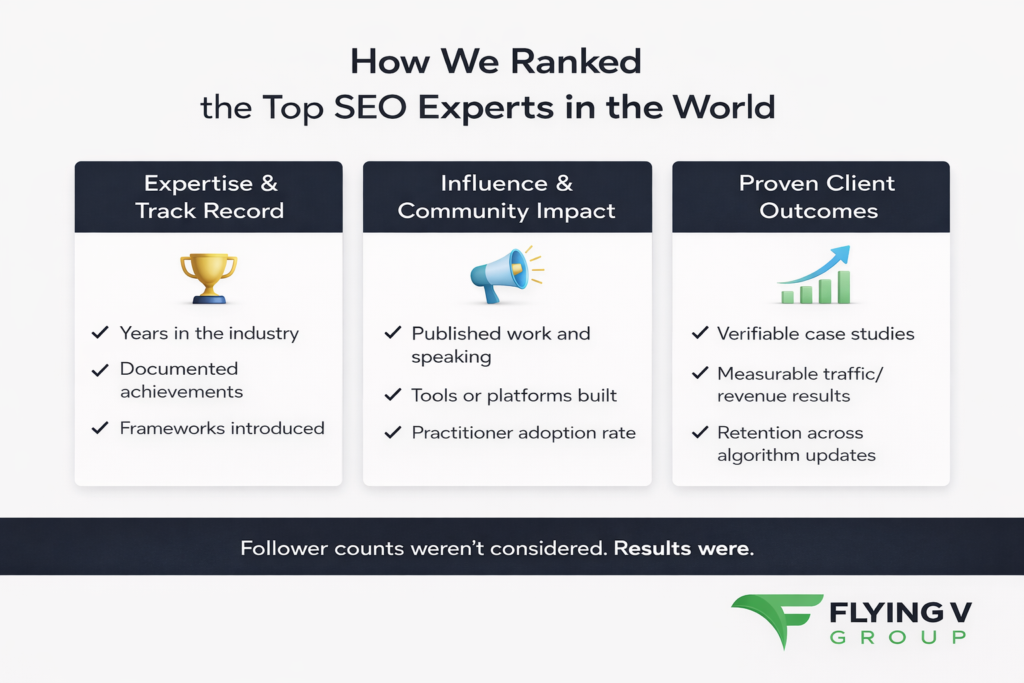
The SEO industry produces more commentary than most fields. The experts above stand out because their contributions are traceable — a named framework, a documented case study, a measurable outcome tied to a specific methodology.
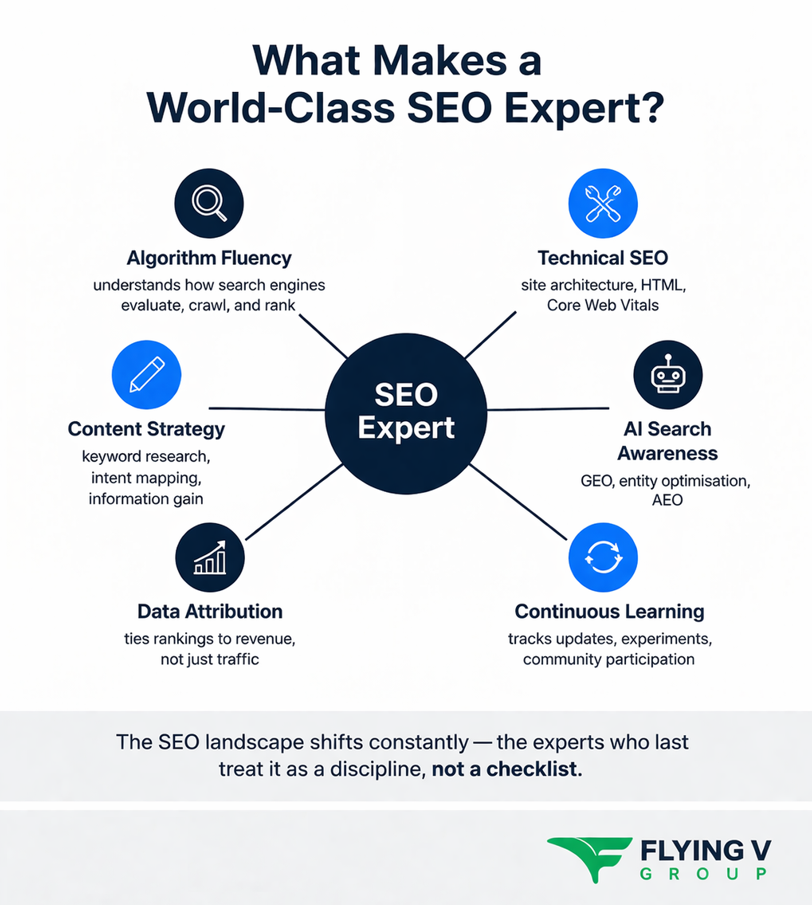
The common thread is that each of them treats SEO as a discipline with cause-and-effect relationships, not a collection of tactics to apply and hope for the best. That distinction matters practically: an expert who understands why something works can adapt when Google changes how that thing is measured.
The Shift Toward GEO and AI Search
Academic research on Generative Engine Optimisation confirms what practitioners are observing: AI search engines prioritise authoritative third-party sources over brand-owned content when generating answers. The experts who saw this coming — Barnard, Haynes on E-E-A-T, Fulford on structured data — were building toward it before “GEO” became an industry term.
The implication for businesses is straightforward: SEO expertise in 2026 requires understanding how to build the kind of entity clarity and third-party citation footprint that AI systems recognise as trustworthy — not just how to rank a page.
Why the Demand for SEO Expertise Keeps Growing
Google still holds approximately 90% of the global search engine market, making search visibility a non-negotiable marketing channel for most businesses. The SEO services market is estimated at over $108 billion in 2026 and projected to exceed $200 billion by 2030 — figures that reflect how central organic search has become to digital revenue strategy.
The SEO software market is simultaneously projected to reach over $154 billion by 2030 as organisations invest more in the tooling required to compete. Both trends point to the same conclusion: the complexity of organic search is increasing, and the gap between businesses with expert guidance and those without it is widening.
Work With an SEO Team That Applies These Principles
Following the experts above provides knowledge. Applying that knowledge to your specific competitive landscape requires execution — and execution requires a team that understands your revenue model, not just your keyword list.
Flying V Group builds SEO strategies that connect technical foundations, content authority, and AI search visibility to actual business outcomes. Contact Flying V Group to review where your current search position stands and what’s worth addressing first.
Frequently Asked Questions
Are the SEO strategies from well-known experts still valid with AI search changing how results appear?
The foundational principles — technical health, authoritative content, entity clarity, quality backlinks — remain the basis of both traditional and AI-driven search visibility. What has changed is the importance of structured content that AI systems can parse and cite. Experts like Jason Barnard and Marie Haynes have been building toward AI-readable content structures for years, which is why their frameworks transfer more cleanly to the current environment than purely tactical SEO advice.
How much do top SEO consultants typically charge?
Independent consultants at the level of those listed here typically charge between $200 and $500 per hour for advisory work, with retainer arrangements for ongoing campaigns ranging from $3,000 to $15,000+ per month depending on scope and market competitiveness. Agency arrangements with full-service teams generally offer more predictable cost structures than individual consultants for sustained campaigns.
What’s the difference between following an SEO expert and hiring one?
Following SEO experts provides frameworks and principles applicable to your own campaigns. Hiring one — whether a consultant or an agency — provides direct analysis of your specific competitive landscape, technical implementation, and ongoing optimisation against your particular ranking targets. The value of hiring scales with the competitiveness of your market and the complexity of your site.
Is SEO still worth investing in given the growth of AI-generated search results?
Google processes billions of searches daily, and AI Overviews typically pull from pages that already rank well organically — making strong SEO a prerequisite for AI search visibility rather than an alternative to it. Businesses with well-optimised sites and authoritative content are more likely to be cited in AI-generated answers, not less.
Which type of SEO expert should a small business prioritise hiring first?
For most small businesses, a technical SEO audit followed by local SEO optimisation produces the fastest return. Technical issues preventing proper crawling and indexing are common and fixable, and the results compound over time. Local SEO directly connects to high-intent nearby searches that convert at higher rates than broader organic traffic. Specialists in link building or GEO become more relevant once the foundational layer is solid.
How do top SEO experts stay current when Google updates its algorithm without public notice?
The most reliable methods are running controlled experiments on live sites, monitoring ranking volatility across large data sets (what Barry Schwartz does publicly through Search Engine Roundtable), and maintaining active participation in professional communities where practitioners share observations in real time. Relying on official Google communications alone is insufficient — major ranking factors are often documented months or years after they become operational.
What tools do the world’s leading SEO experts actually use?
Semrush and Ahrefs are the most commonly referenced platforms for keyword research, backlink analysis, and competitive intelligence. Google Search Console remains the primary source of first-party performance data. For technical audits, Screaming Frog is standard. Jason Barnard’s Kalicube Pro is the dominant platform for entity and AI visibility tracking. The specific combination varies by specialisation — there is no single universal stack across technical, content, and GEO practitioners.