
Most businesses that get burned by SEO didn’t know they were doing anything wrong. They hired an agency, rankings went up, and then one algorithm update later — or worse, a manual action — traffic dropped by 60% and nobody could explain why. The agency was using tactics that worked until they didn’t.
Ethical SEO isn’t a philosophical stance. It’s the only approach that compounds over time without carrying the risk of losing everything you built. This guide breaks down what it actually means in practice, what the alternatives cost, and how to verify that the agency you’re working with is doing it right.
At Flying V Group, our entire SEO methodology is built around white-hat practices tied to revenue outcomes. If you want to see what that looks like applied to your business, reach out to our team for a free consultation.
What is Ethical SEO?
Ethical SEO, also known as white-hat SEO, refers to the practices that comply with search engine guidelines and focus on creating long-term value for users and businesses. These techniques prioritize transparency, fairness, and honesty, ensuring a business’s website remains trustworthy and reliable in the eyes of both search engines and customers.
In contrast, unethical SEO (black-hat SEO) includes manipulative techniques such as keyword stuffing, cloaking, and using link farms to artificially boost rankings. While these methods may offer short-term results, they come with significant risks. Google and other search engines frequently update their algorithms to identify and penalize these practices. Websites caught using black-hat techniques can face severe consequences, including being removed from search engine results or being permanently banned, damaging their reputation.
Ethical SEO focuses on the long-term health of a website by following established search engine guidelines. The core principles of ethical SEO are:
- Transparency: Providing clear, truthful information without trying to deceive search engines or users.
- Fairness: Ensuring that your website content meets user expectations and doesn’t rely on artificial tactics to manipulate rankings.
- Honesty: Building content and gaining backlinks based on genuine value and relevance, rather than through dishonest or spammy tactics.
The Role of Ethical SEO in Sustainable Growth
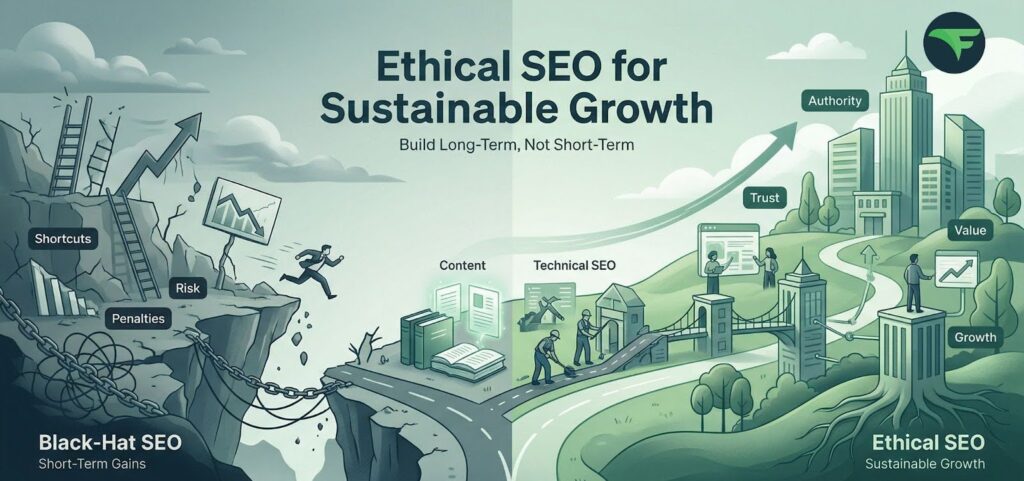
The real argument for ethical SEO isn’t philosophical, it’s financial. Black-hat tactics work until they don’t, and when they stop working the damage is rarely limited to a rankings drop. Manual penalties can remove pages from search results entirely. Algorithmic updates like Google’s core updates and link spam updates have wiped out years of organic growth for sites that built authority through manipulative means. Recovery from a manual action typically takes 6-12 months of remediation work, assuming the toxic links can even be identified and removed.
Harmful backlinks are one of the most common culprits. Sites that acquired links through PBNs or paid placements often don’t realize the liability sitting in their backlink profile until a penalty lands.
What Ethical SEO Actually Builds
Ethical SEO compounds in a way manipulative tactics can’t. Each piece of quality content, each editorially earned link, and each technical improvement stacks on the last. Organic search built on legitimate signals doesn’t disappear when an algorithm updates. It adjusts, holds, and often improves as competitors using shortcuts get filtered out.
The compounding effect shows up in a few specific ways:
- Content authority: pages that earn links and engagement naturally tend to rank for more keyword variations over time, not fewer
- Domain trust: a clean backlink profile and consistent E-E-A-T signals make future content easier to rank
- Conversion quality: organic traffic built on genuine relevance converts at higher rates than traffic chased through keyword manipulation
Understanding how content marketing fits into this matters separately. Content that answers real questions builds topical authority over time, which is the mechanism behind most sustained organic growth.
The Risk Math
The businesses that choose black-hat tactics are essentially borrowing future organic revenue. They get results faster, but the liability grows with every link purchased and every manipulative tactic deployed. Ethical SEO takes longer to show results, typically 4-6 months before meaningful traffic gains in competitive markets, but it doesn’t carry that liability. For most businesses, that tradeoff is straightforward once it’s framed correctly.
Key Components of Ethical SEO Services
To achieve lasting results, ethical SEO requires a combination of components working together. Here’s what each one looks like when done properly.
On-Page Optimization
On-page SEO covers title tags, meta descriptions, header structure, and keyword placement, but the part most agencies get wrong is intent alignment. A page optimized for the right keyword but built for the wrong intent, informational content on a page designed to convert, will rank poorly regardless of how well everything else is done. Good on-page work starts with understanding what the searcher actually wants before touching a single title tag.
Content Creation
Quality content isn’t measured by word count or publishing frequency. It’s measured by whether it adds something competitors haven’t already covered. A strong content SEO strategy identifies the specific questions your audience is asking, maps those questions to stages of the buying journey, and produces content that earns rankings because it’s genuinely more useful than what’s already ranking. Anything less is filling a calendar, not building authority.
Link Building
Ethical link building means editorially earned links from relevant, authoritative sources. The clearest signal that an agency is cutting corners: they can’t tell you specifically where your links are coming from or why those sites are relevant to your industry. A legitimate link building program prioritizes relevance and authority over volume and never involves paying directly for placement.
What to watch for in a link profile:
- High volumes of links from unrelated industries
- Sudden spikes in link acquisition with no corresponding content campaign
- Links from sites with no organic traffic of their own
Technical SEO
Technical SEO and content SEO are often treated as separate workstreams, but they depend on each other. A technically sound site ensures search engines can crawl, render, and index your content correctly. The benchmarks that matter most in 2026: Largest Contentful Paint under 2.5 seconds, Cumulative Layout Shift under 0.1, and zero critical crawl errors in Google Search Console. If your agency can’t speak to these specifically, technical SEO isn’t being done properly.
E-E-A-T
Experience, Expertise, Authoritativeness, and Trustworthiness is how Google’s quality raters evaluate content, particularly in competitive or sensitive categories. For ethical SEO, E-E-A-T isn’t a checklist item, it’s the output of doing everything else correctly. Author credentials, accurate sourcing, transparent business information, and content that demonstrates genuine subject matter knowledge all contribute. Sites that score well on E-E-A-T tend to be more resilient to algorithm updates because they’re doing what Google is trying to reward.
How to Choose an Ethical SEO Service Provider
When selecting an SEO service provider, it’s important to find an agency that aligns with your business goals and values. Here are some tips to help you make the right choice:
- Review Their Approach: Ensure the provider follows ethical SEO practices. Ask about their strategies and how they stay up-to-date with the latest search engine guidelines.
- Transparency: Look for a provider that is transparent about their processes, progress, and results. They should be able to explain how their strategies align with your business needs.
- Case Studies and Testimonials: Review case studies and client testimonials to gauge the provider’s track record. A reliable SEO provider should have proven success with businesses similar to yours.
- Customization: Choose an agency that offers tailored SEO strategies, rather than one-size-fits-all solutions. Your business’s needs will differ from others, so a customized plan is crucial for long-term success.
At Flying V Group, we specialize in ethical SEO services tailored to your specific business needs. With a focus on transparency, measurable results, and sustainable growth, we ensure that your online presence flourishes in a way that aligns with search engine guidelines and user expectations.
Ethical SEO Best Practices to Implement
To ensure your business benefits from ethical SEO services, there are several best practices you can implement immediately. First, optimizing your website content is key. Focus on creating high-quality, informative content that serves both search engines and users. Use targeted keywords naturally throughout your content, ensuring they align with what potential customers are searching for. However, avoid keyword stuffing, as this can harm your SEO rankings.
Improving the user experience (UX) is another essential part of ethical SEO. Google values websites that provide seamless navigation, fast loading times, and a mobile-friendly design. A user-friendly website encourages visitors to stay longer and engage more, which can improve your rankings. Make sure your website is optimized for mobile, as more and more users search for services on their phones.
Local SEO is especially crucial for businesses targeting a specific geographic area. By optimizing for local search terms, creating and maintaining a Google My Business listing, and getting local reviews, you can increase your visibility for searches like “dry cleaning near me” or “plumbing in [city].” Local SEO ensures your business stands out to customers in your area, driving both foot traffic and online conversions.
Monitoring your SEO efforts is also crucial for success. Track your website’s performance using tools like Google Analytics and Search Console. Keep an eye on key metrics such as traffic, bounce rate, and conversions. Regular monitoring will help you identify what’s working and what needs improvement.
Finally, staying updated with Google’s algorithm changes is vital to maintaining ethical SEO practices. SEO is constantly evolving, so adapting to new rules is essential to stay on top of rankings. Flying V Group helps businesses like yours stay ahead by using ethical SEO services that align with the latest trends and updates. We deliver tailored strategies that evolve with Google’s algorithm, ensuring your business stays relevant and visible.
Conclusion: Invest in Ethical SEO for Long-Term Success
Ethical SEO is essential for building a strong online presence and ensuring long-term business growth. Businesses prioritizing ethical SEO services are better positioned for success, as they build trust with search engines and users.
At Flying V Group, we specialize in crafting ethical SEO strategies tailored to your specific needs, helping your business grow sustainably.
Partner with us to implement effective, transparent, and results-driven SEO practices that will set your business up for long-term success and longevity. Start optimizing your online presence with ethical SEO services today!
FAQs
What is the difference between ethical SEO and black-hat SEO?
Ethical SEO follows search engine guidelines and builds visibility through legitimate means: quality content, editorially earned links, and sound technical foundations. Black-hat SEO uses manipulative tactics like keyword stuffing, paid link schemes, and cloaking to artificially inflate rankings. The practical difference is risk. Black-hat tactics can produce faster results but carry the constant threat of manual penalties or algorithmic filtering that can wipe out rankings overnight. Ethical SEO takes longer but doesn’t carry that liability.
How long does ethical SEO take to show results?
For low-competition local keywords, expect ranking movement within 8-12 weeks. Moderate-competition terms typically show meaningful traffic gains at 4-6 months. Highly competitive categories can take 9-18 months to produce consistent organic leads. The timeline is longer than black-hat approaches but the results hold and compound rather than disappearing when an algorithm updates.
How do I know if my current SEO provider is using ethical practices?
Ask for a full backlink report and check where links are coming from. Ask to see the monthly reporting template and confirm it tracks conversions, not just rankings. Ask specifically whether they’ve ever used PBNs or paid link placements. A provider doing ethical work can answer all three questions clearly and specifically. Vague answers are a red flag worth acting on.
Does ethical SEO work for AI search as well as Google?
Yes, and increasingly so. AI search systems like Perplexity and Google AI Overviews favor structured, authoritative, machine-readable content, which is exactly what ethical SEO produces. Schema markup, E-E-A-T signals, and content that genuinely answers user questions all contribute to visibility in AI-generated responses. Sites built on manipulative tactics tend to get filtered out of AI citations entirely.
Can ethical SEO recover a site that’s already been penalized?
Yes, but recovery takes time and depends on the penalty type. A manual action requires identifying and removing or disavowing toxic links, submitting a reconsideration request, and waiting for Google to review the site, a process that typically takes 3-6 months. Algorithmic penalties recover as Google recrawls and re-evaluates the site after issues are fixed, which can take several crawl cycles. Flying V Group has helped businesses work through both scenarios. If you suspect a penalty is suppressing your traffic, contact our team for a diagnostic.