
Referrals still matter. But hiring decisions rarely begin and end with a personal recommendation. Most people research a law firm online before making contact, and a firm’s website, online reviews, and digital presence play a significant role in building trust. At the same time, the American Bar Association reports that law firm websites, SEO, content marketing, and social media have become core components of client acquisition as firms continue investing in digital marketing technology.
The firms growing fastest are not the ones spending the most on advertising. They are the ones with a deliberate digital presence that earns trust before a prospective client picks up the phone. Flying V Group works with legal firms to build exactly that. Get in touch to discuss what a client growth programme looks like for your practice.
The State of Legal Marketing in 2026
A Digitally Competitive Industry
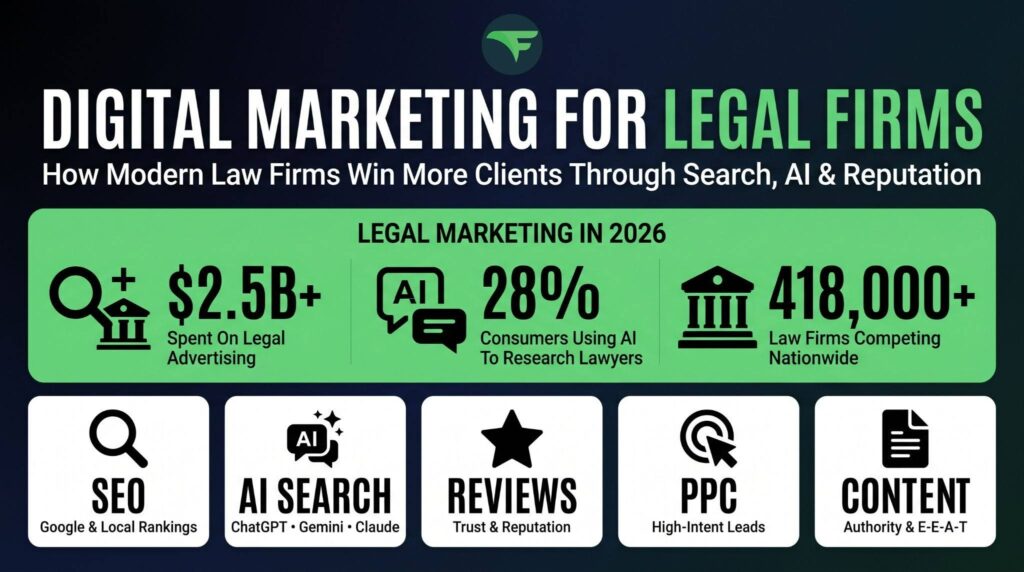
The legal services market is not just competitive. It is heavily advertised. More than $2.5 billion was spent on over 26.9 million legal ads across all media in the U.S. in 2024, with 418,181 law firms operating across the country, according to law firm marketing benchmarks published by RevenueMemo.
Law firms typically allocate 2-10% of total revenue toward marketing, with 45% going to SEO, 30% to PPC, and 10% to social media. For firms without a formalised digital budget, that benchmark is a useful starting point.
AI Search Has Entered the Picture
AI-powered search is changing how prospective clients discover and evaluate law firms. Rather than relying solely on traditional search engines, consumers are increasingly using conversational AI to research services, compare providers, and summarize complex information before making contact.
At the same time, research on Generative Engine Optimization (GEO) published in 2025 found that AI search engines such as ChatGPT, Gemini, Claude, and Perplexity systematically favor third-party earned media over brand-owned content when generating recommendations, making authoritative mentions, reviews, and media coverage increasingly important for law firms seeking visibility in AI-generated answers.
For legal firms, this means a website alone is no longer sufficient. Attorney directories, earned press coverage, verified client reviews, and consistent business information across platforms all contribute to the citation authority that AI engines use to recommend legal providers.
Channel 1: SEO and Local Search
Why Legal SEO Is YMYL Territory
Legal services fall under Google’s YMYL (Your Money or Your Life) classification, meaning Google’s Search Essentials requires demonstrable expertise, authoritativeness, and trustworthiness on all practice area pages. A practice area page without proper attorney attribution, credentials, or cited legal references will underperform against properly attributed content regardless of keyword targeting.
Local SEO and the Map Pack
For most legal practices, local search drives more qualified leads than broad organic rankings. Google’s local ranking factors — relevance, distance, and prominence — govern Map Pack placement. A family law attorney in Phoenix competing for “divorce lawyer Phoenix” needs a well-configured Google Business Profile with consistent reviews, accurate category selection, and NAP (name, address, phone) consistency across directories.
Solo firms using digital client intake tools including e-signatures, intake forms, and schedulers reported 53% higher revenue and 48% more client leads than those without, according to Clio’s 2025 Legal Trends Report. Local SEO feeds directly into this intake funnel.
Channel 2: PPC and Paid Search
High CPCs, High Intent
Legal PPC is expensive. Keywords like “car accident lawyer” regularly exceed $50-$100 per click in competitive markets. That cost reflects the value of the leads — a single retained client can return multiples of the monthly spend.
Keyword precision is everything. Tightly themed ad groups targeting problem-aware queries attract prospective clients at the decision stage rather than the information stage.
Compliance With Advertising Rules
The ABA Model Rules of Professional Conduct, particularly Rules 7.1, 7.2, and 7.3, govern attorney advertising across all channels. Rule 7.1 prohibits false or misleading communications. Rule 7.2 addresses referral payments. Rule 7.3 governs direct solicitation. States including Florida, California, and New York impose additional requirements. A campaign that violates professional conduct rules creates bar liability for the firm, not the agency.
Channel 3: Content Marketing and E-E-A-T
Educational Content as a Client Acquisition Tool
Legal content marketing serves two functions: it builds the E-E-A-T signals Google requires for YMYL content, and it earns the trust of prospective clients researching before they reach out. A well-researched article on “what happens at a custody hearing in [state]” ranks for high-intent queries and positions the firm as credible before the first consultation.
Nearly 60% of consumers say online reviews outweigh personal referrals when evaluating a legal firm, per Scorpion’s 2025 consumer study. Content that demonstrates genuine legal expertise reinforces that review signal with a compounding credibility effect paid advertising cannot replicate.
Blog Writing and Practice Area Pages
The content that performs best for legal firms addresses specific legal situations, explains the process, and answers the questions that bring people to Google in the first place. Flying V Group’s blog writing practice produces attorney-attributed legal content structured for both search ranking and AI citation. Practice area pages with jurisdiction-relevant content attributed to a named attorney carry materially more ranking weight than generic shared pages.
Channel 4: GEO and AI Search Visibility
Why ChatGPT Is Now a Legal Referral Source
28.1% of legal consumers used ChatGPT to research a lawyer in 2025, up from 20.5% in 2024 and 9% in 2023, per iLawyer Marketing’s research. That is not a niche behaviour — it is one in four prospective clients using an AI tool as part of their firm selection process. Legal firms not visible in AI-generated recommendations are invisible to a growing share of the market.
GEO (Generative Engine Optimisation) for legal firms specifically involves building the citation profile that AI engines draw on. Strong profiles on Avvo, Martindale-Hubbell, FindLaw, and Google, combined with structured practice area content and earned press mentions, contribute to the third-party citation authority that makes a firm recommendable by AI search engines.
Attorney Directories as GEO Infrastructure
Attorney directories function as citation sources in AI search in the same way backlinks function in traditional SEO. Consistent, complete, and updated profiles across legal directories strengthen the entity information that AI engines use to validate and recommend attorneys. Flying V Group’s GEO practice structures this citation architecture alongside on-site content for full-funnel AI search visibility.
Channel 5: Reputation Management and Reviews
Firms using client intake technology see 51% more leads and 52% higher revenue on average, per Clio’s Legal Trends Report, but that intake pipeline depends on the reputation that precedes it. 74% of legal clients research a firm after receiving a referral, meaning even word-of-mouth leads validate their decision digitally before reaching out.
Review acquisition should be systematic, not sporadic. Asking clients for a Google review at case conclusion, following up via text with a direct link, and responding to every review on record signals active reputation management. Review volume and recency influence both Map Pack rankings and the third-party signals that AI engines weight when recommending attorneys.
What to Avoid
Paid reviews, incentivised testimonials, and manufactured endorsements violate Google’s review policies and create bar exposure under the ABA’s prohibition on false or misleading communications. Reputation management for legal firms must operate within both platform terms and professional conduct rules simultaneously.
What to Measure Beyond Rankings
Most legal marketing reporting stops at rankings and traffic. The metrics that connect digital marketing to firm growth are:
| Metric | Why It Matters |
| Organic consultation requests | Connects SEO directly to pipeline |
| Cost per retained client by channel | Compares SEO, PPC, and referral economics |
| Map Pack visibility for practice area queries | Tracks local search competitiveness |
| Review velocity and average rating | Influences both local rankings and AI citations |
| AI Overview or ChatGPT appearances | Tracks GEO effectiveness |
| Intake form completion rate | Identifies conversion friction post-click |
Only 47% of law firms have a formal annual marketing budget, per RevenueMemo’s 2026 benchmarks, and the gap in tracking is even wider. Firms that close this measurement gap grow budgets and results faster than those operating on intuition alone.
Build a Client Acquisition System That Works Beyond Referrals
Flying V Group builds SEO, GEO, and web design strategies for legal firms that need digital marketing working as a consistent client acquisition channel. Let us map out what that looks like for your practice.
Frequently Asked Questions
What is digital marketing for law firms?
Digital marketing for law firms covers SEO and local search, PPC, content marketing, Google Business Profile management, reputation management, and GEO for AI search visibility. It operates under the additional constraint of ABA Model Rules governing attorney advertising, which prohibit false or misleading communications about legal services.
How much should a law firm spend on digital marketing?
Law firms typically allocate 2-10% of total revenue toward marketing, with approximately 45% going to SEO and 30% to PPC. In 2025, 69% of smaller firms and 79% of larger firms planned to increase their marketing budgets within the next 12 months.
Why is SEO important for law firms?
96% of people seeking legal advice begin their research with a search engine. For practice areas with high client lifetime value, organic visibility compounds significantly over time compared to paid channels that stop generating results when spend stops.
What are the ABA rules on law firm advertising?
ABA Model Rules 7.1, 7.2, and 7.3 cover attorney advertising across all digital channels. Rule 7.1 prohibits false or misleading communications. Rule 7.2 addresses referral payments. Rule 7.3 governs direct solicitation. Most states have adopted these rules with additional local requirements.
How do law firms appear in ChatGPT and AI search results?
AI engines draw on third-party citation profiles rather than a firm’s website alone. Complete profiles on Avvo, Martindale-Hubbell, and FindLaw, combined with earned media and strong reviews, contribute to the citation authority that AI engines use to recommend legal providers.
What content works best for law firm digital marketing?
The highest-performing legal content addresses specific legal situations, explains processes in plain language, and is attributed to named attorneys with verifiable credentials. Practice area pages with jurisdiction-specific content consistently outperform generic firm pages.
How do reviews affect a law firm’s online visibility?
Reviews influence both Google Map Pack rankings and AI search recommendations. Nearly 60% of legal consumers say online reviews outweigh personal referrals in their hiring decision, making review management one of the highest-leverage activities in legal digital marketing.