
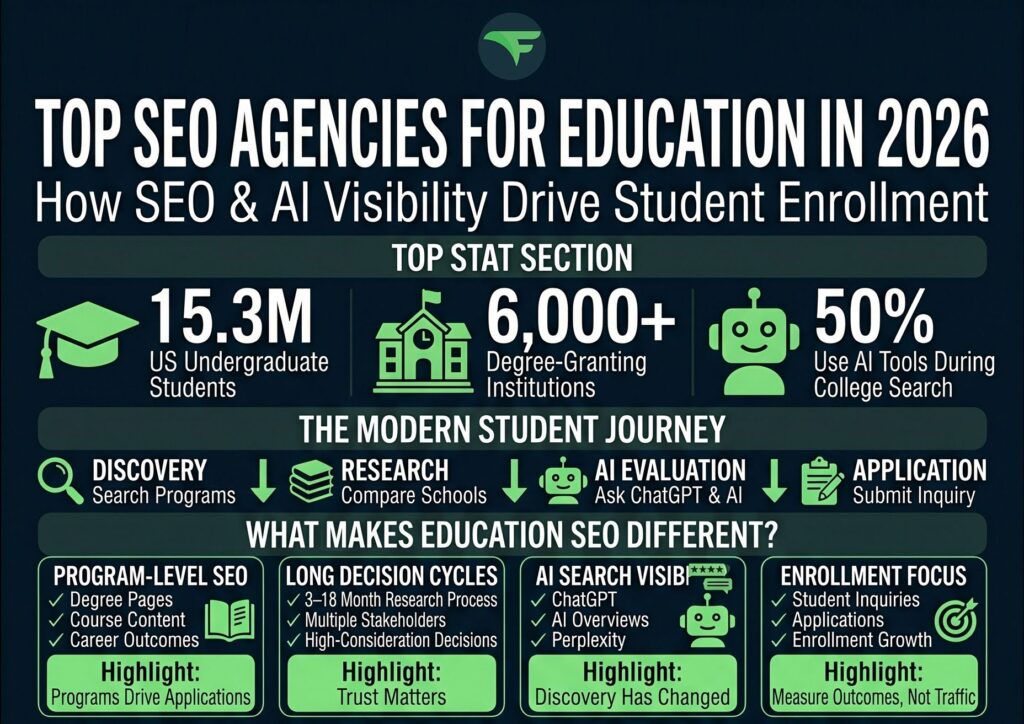
Postsecondary enrollment in the US reached 15.3 million undergraduates in spring 2025, up 3.2% year-over-year — and over 6,000 degree-granting institutions are competing for those students. That competition plays out online: students research programs across multiple searches over weeks or months before submitting an application, and research published in 2025 confirmed that half of prospective students now use AI tools at least weekly during their college search. Institutions not visible in Google’s organic results, AI Overviews, or ChatGPT recommendations are absent from a significant portion of that decision process.
Flying V Group works with education clients across K-12, higher education, and EdTech to build SEO and GEO strategies that generate consistent student inquiry pipelines. Contact us to discuss what that looks like for your institution.
What Makes Education SEO Different From Traditional SEO
Long Decision Cycles and Program-Level Intent
Education SEO operates on a fundamentally different timeline and decision structure than most industries. A prospective student researching MBA programs may spend three to eighteen months from first search to application submission. Their parents often participate. Financial aid availability shapes outcomes. And the institution is competing not just against peer schools, but against aggregators, ranking sites, bootcamps, and online certificate providers, all targeting the same keywords.
Program Pages Drive Enrollment, Not Homepages
Program pages, not homepages, are where enrollment decisions are made. A student searching “online nursing degree with clinical placements” needs a page that answers their specific question — not a homepage that sells the institution broadly. Institutions with optimised, intent-specific program pages consistently outperform those routing all traffic through generic entry points.
AI Search Has Changed Student Discovery
AI search has added another dimension. Google AI Overviews, ChatGPT, and Perplexity increasingly answer program-specific queries directly, recommending institutions based on citation authority and content structure rather than rankings alone. The agencies below understand that distinction.
Top 5 SEO Agencies for Education in 2026
1. Flying V Group
Best for: Education businesses and institutions that need SEO and GEO working together across the full student acquisition funnel
Flying V Group is a full-service digital marketing and advertising agency founded in 2016 in Newport Beach, California. Our SEO and GEO work spans technical architecture, program-level content strategy, digital PR for earned citations, and AI search visibility — the full stack required to reach prospective students across both traditional and generative search surfaces.
Core Specialties / Community and Track Record
We’ve worked with clients across professional services, healthcare, and financial sectors, bringing the same ROI-focused methodology to education clients. Most agencies optimise for rankings. We optimise for P&L impact — which in education means applications and enrollments, not traffic reports. Our content marketing and blog writing teams produce program-level content built for both search intent and AI citation eligibility, while our web design practice ensures the technical foundation supports both.
Ideal client: Higher education institutions, EdTech companies, and training providers that measure marketing success by enrollment outcomes, not session counts.
2. Manaferra
Best for: Universities and colleges that need enrollment-focused SEO from a higher education specialist
Manaferra is a Brooklyn-based agency that works exclusively with higher education institutions — universities, colleges, business schools, nursing schools, and law schools. That singular focus produces a depth of enrollment funnel knowledge that generalist agencies struggle to replicate. Their Omnichannel SEO™ methodology targets every search surface relevant to prospective students, from Google to AI-powered engines.
Their results are well documented. After a website redesign caused a 70% drop in organic traffic for the University of the Potomac during a critical enrollment period, Manaferra delivered a 1,423% increase in SEO-driven leads, a 447% rise in organic traffic, and a $125,000 monthly increase in traffic value. They have also won the Best Use of SEO for Higher Education award at both the US Search Awards and the Global Search Awards. University partnerships typically range from $5,000–$15,000 per month based on institution size and programme complexity.
Ideal client: Four-year universities, graduate schools, and professional programme institutions with competitive enrolment targets and complex programme page architectures.
3. Think Orion
Best for: International student recruitment and creative performance marketing for higher education
Think Orion is a Singapore-based education marketing agency with offices in Dubai and Toronto, specialising in international student recruitment and demand generation for online programmes. Their proprietary VALA™ framework maps the student journey from awareness through enrolment, ensuring SEO and paid media work in sequence rather than in parallel silos. A 728% traffic growth case study published in 2025 shows their content-led SEO capability in practice.
Think Orion published formal research on SEO and GEO in education marketing in March 2025, demonstrating active engagement with AI search dynamics rather than retrofitting old playbooks. Their strongest asset is creative performance — particularly for institutions targeting international applicants across Southeast Asia, the Middle East, and South Asia.
Ideal client: Universities and online programme providers with international enrolment targets, particularly in Asia-Pacific and Middle East markets.
4. Markitors
Best for: K-12 schools, small colleges, and local education providers prioritising local SEO
Markitors is a Phoenix-based agency with a track record across schools, trade programmes, and smaller educational institutions. Their approach begins with an audit and strategy session before moving into content, link outreach, technical optimisation, and local SEO — a methodical sequence suited to institutions with modest budgets and local recruitment goals. They have worked with private schools, daycare networks, and preschool operators, making them one of the few agencies with genuine K-12 and early education SEO depth.
Their pricing is more accessible than higher education specialists, which suits community colleges, independent schools, and local training providers that need strong local search visibility without the retainer structures of enterprise-focused agencies.
Ideal client: K-12 schools, community colleges, trade schools, and local educational providers focused on regional student acquisition.
5. SEO.com
Best for: Institutions seeking broad SEO execution with strong technical capabilities
SEO.com has been providing search optimisation services since 2007, with experience spanning universities, schools, and EdTech platforms. Their service model covers technical SEO audits, keyword research, content creation, link building, and customised strategy — a well-rounded execution capability that suits institutions with complex site architectures and multiple programme verticals. Detailed reporting and performance transparency are consistently cited by clients as strengths.
While less education-specialised than Manaferra or Think Orion, SEO.com’s technical depth makes them a capable partner for institutions that need site-wide remediation, speed optimisation, and crawlability improvements alongside programme-level content work.
Ideal client: Universities and EdTech platforms with technically complex websites requiring site-wide SEO remediation and ongoing content production.
How to Choose the Right Education SEO Agency
The right agency depends on where your institution sits on two axes: how specialised your needs are, and what stage of the funnel you need to move.
| Need | Best Fit |
| Enrollment-focused higher ed SEO with AI search | Manaferra or Flying V Group |
| International student recruitment | Think Orion |
| K-12 or local institutional visibility | Markitors |
| Technical SEO and site-wide remediation | SEO.com |
| Full-service digital + SEO + GEO integration | Flying V Group |
The questions worth asking any agency before engagement: Do they understand your enrolment cycle and seasonal search patterns? Can they show programme-page specific results rather than aggregate traffic growth? Do they have a defined approach to AI search visibility, not just traditional rankings? And do they track applications and enrolment as primary KPIs rather than session counts?
Work With an SEO Partner That Measures Success by Enrollments
Flying V Group works with education businesses and institutions to build SEO and GEO strategies calibrated to student acquisition, not vanity metrics. Contact us to see what that looks like for your programmes and markets.
Frequently Asked Questions
What is education SEO?
Education SEO is the practice of optimising an institution’s website and content to appear in search results when prospective students research programmes, degrees, and educational providers. It encompasses programme-page optimisation, local SEO, technical site health, digital PR for earned authority, and increasingly, GEO — structuring content to appear in AI-generated search answers from Google AI Overviews, ChatGPT, and Perplexity.
How does SEO help universities increase enrollment?
SEO increases enrollment by ensuring an institution’s programme pages appear when prospective students search for specific degrees, locations, or educational formats. Research consistently shows that students conduct multiple searches over weeks or months before applying, and institutions visible across that research journey — from discovery queries to programme-specific intent searches — generate more qualified inquiries than those relying on branded or transactional visibility alone.
What makes education SEO different from traditional SEO?
Education SEO involves longer decision cycles (often 3–18 months from first search to application), multiple stakeholder audiences (prospective students, parents, adult learners, international applicants), seasonal search demand aligned to enrolment windows and application deadlines, and programme-level keyword complexity that generic SEO strategies rarely account for. Institutions also compete against aggregators and ranking sites for the same keywords, requiring a different content architecture than most industries.
How much does education SEO cost?
Education SEO pricing varies significantly by agency specialisation and institution size. Specialist higher education agencies like Manaferra typically charge $5,000–$15,000 per month for university partnerships. Generalist agencies and local SEO providers like Markitors offer more accessible pricing for smaller institutions. Full-service agencies covering SEO, GEO, and content production are typically positioned between those ranges depending on scope.
How long does education SEO take to produce results?
Most education SEO campaigns begin generating measurable organic traffic improvements within 3 to 6 months. Meaningful enrolment impact typically builds through the 6 to 12 month range. Institutions in highly competitive programme categories — MBAs, online nursing, computer science — often require sustained investment over 12 months or more before organic becomes a primary inquiry channel.
Can SEO help institutions appear in ChatGPT and AI search answers?
Yes — but it requires a different approach than traditional SEO. AI search engines favour institutions with strong third-party citation profiles, well-structured programme content, authoritative faculty expertise signals, and consistent entity information across the web. A 2025 study found that half of prospective students now use AI tools at least weekly during their college search, making AI search visibility a meaningful and growing component of student acquisition strategy.
What metrics should educational institutions track for SEO?
Beyond keyword rankings, education SEO metrics worth tracking include organic programme page traffic, inquiry form submissions attributed to organic search, application volume from organic sessions, cost per organically acquired inquiry versus paid channels, and AI Overview or featured snippet visibility for high-intent programme searches. Enrolment attribution across a multi-month decision cycle requires proper UTM tracking and CRM integration to surface accurately.