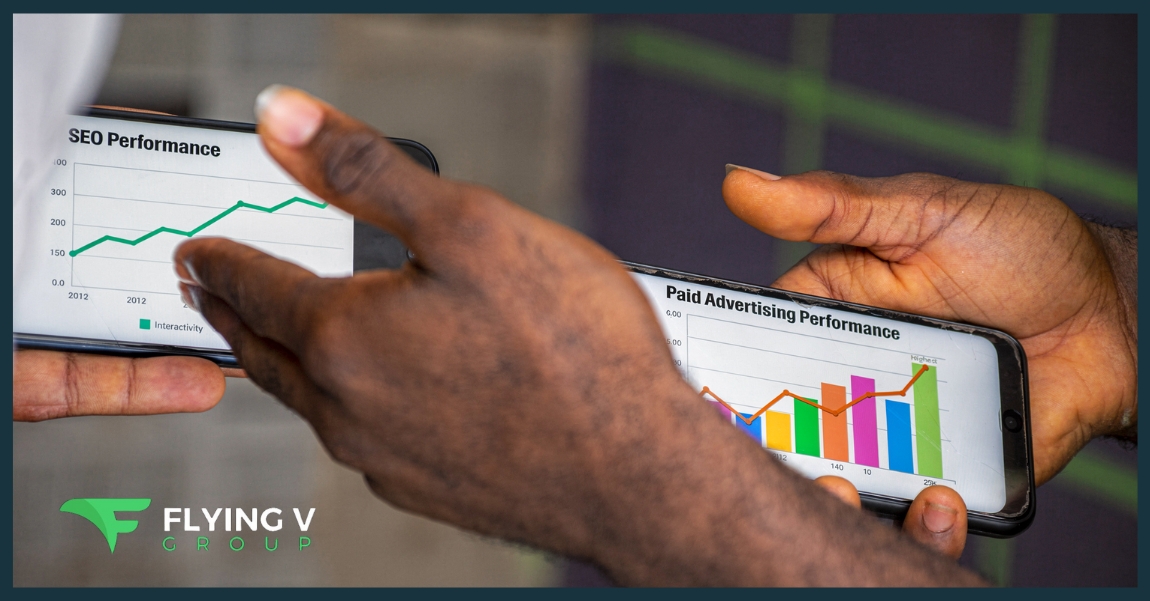
The real question isn’t whether SEO or paid advertising works. It’s which one deserves your next dollar, and that answer changes depending on your timeline, budget, and how much organic search has already changed under AI Overviews.
Flying V Group builds SEO and PPC strategies that work together rather than compete for the same budget line. Contact us to talk through the right mix for your business.
How Fast Each Channel Produces Results
Paid advertising can generate traffic as soon as an eligible campaign starts winning auctions. SEO works differently, and Google is direct about it.
Google’s own guidance on Search performance states that improvements to a site can sometimes affect Search within days, but recognizing longer-term improvements can take several months. Google also explicitly says there is no guarantee that changes will produce a noticeable Search impact at all.
The Real Cost Structure Behind Each Channel
The common comparison, that SEO is free and paid advertising costs money, misses how each channel is built. Paid search runs on cost-per-click pricing, and Google’s own documentation confirms that actual CPC is determined through the ad auction, meaning advertisers are often charged less than their maximum bid depending on competition and Ad Rank.
SEO doesn’t carry that same per-click fee. But producing and maintaining the content, technical infrastructure, and authority that earns organic visibility still costs real money in research, writing, development, and ongoing upkeep.
Auction Position Isn’t Something You Simply Buy
A bigger budget doesn’t guarantee a top ad position. Google explains that ad placement depends on bid, ad and landing page quality, Ad Rank thresholds, and how competitive the auction is at that moment, not simply who bids highest.
Control and Targeting: Where Paid Has a Genuine Edge
Paid advertising lets marketers pick the objective directly. Google Ads supports bidding strategies built around different goals, including conversions, clicks, or visibility, and campaigns can be adjusted toward whichever outcome matters most right now.
SEO has no equivalent lever. There is no setting that tells Google to send a page ten thousand extra visits tomorrow, which makes paid advertising the clearer choice when a business needs an immediate, controllable response.
Paid Search Can Be Measured Against Revenue, Not Just Clicks
Paid advertising offers a cleaner feedback loop than most people give it credit for. Google Ads reporting provides conversion rate, conversion value, and return on ad spend, letting advertisers judge campaigns against actual business value rather than raw click counts.
That doesn’t mean the feedback loop is flawless. Spend still needs to be weighed against what each conversion is genuinely worth, since a cheap click that never converts costs more in the long run than an expensive click that reliably does.
A Simple Way to Calculate Break-Even Before You Commit Budget
Run the math before assuming either channel is winning. For paid search: multiply cost per click by the number of clicks needed to generate a sale, then divide by the number of resulting customers to get a real cost per acquisition.
A $10 CPC across 100 clicks is $1,000 in spend. If five of those clicks become customers, that’s a $200 acquisition cost, a number worth comparing directly against customer lifetime value before scaling the campaign further.
SEO’s break-even math works differently, since the investment goes into building the asset rather than paying per click. Compare the total cost of producing and maintaining a page against the conversions it generates over a full year, not just its first month online, since organic content often takes time to reach its earning potential.
What Happens When You Stop Spending
This is the structural difference that matters most. Turn off a paid campaign, and the traffic stops the same day. Organic content that already ranks can keep attracting visitors long after the work that built it was finished.
That said, organic rankings aren’t a permanent asset either. Google notes that Search results stay dynamic because user expectations shift and the web continually adds new and updated content, meaning today’s ranking isn’t guaranteed to hold without ongoing maintenance.
The Attribution Problem Nobody Likes to Admit
Reports that credit a single channel with an entire conversion usually oversimplify the customer journey. GA4’s attribution documentation illustrates journeys involving multiple channels, such as a visitor who sees a display ad, encounters social content, clicks a paid search ad, and later returns through organic search before converting.
Google Analytics classifies Paid Search and Organic Search as separate channels alongside Paid Social, Organic Social, and others. Comparing SEO against “paid advertising” broadly is less useful than comparing it against the specific paid channel competing for the same query or audience.
Measure the Two Channels Together, Not Separately
Judging SEO and paid advertising from two disconnected dashboards produces a distorted picture. GA4’s key event path reporting shows how different touchpoints along a customer’s path contribute to a conversion, and its model comparison tool shows how the value assigned to each channel shifts depending on which attribution model is applied.
A last-click report might hand a paid search campaign full credit for a sale that an organic blog post introduced weeks earlier. Switching to a data-driven attribution model instead of last-click often reveals that assisting channels, including SEO, deserve more credit than a simple click-count comparison would suggest.
Before declaring one channel the winner, confirm which attribution model produced that conclusion, since the same data can tell two very different stories depending on the lens applied to it.
AI Search Is Changing the Organic Side of the Equation
Anyone comparing these two channels in 2026 has to account for how AI Overviews have reshaped organic click behavior. The Pew Research Center analyzed the real browsing activity of 900 U.S. adults across nearly 69,000 Google searches and found that when an AI-generated summary appeared, users clicked a traditional search result in just 8% of visits, compared to 15% when no summary appeared.
The same study found users were more likely to end their browsing session entirely after seeing an AI summary, at 26%, compared to 16% for standard results. That shift makes paid search, GEO, and organic strategy increasingly interconnected rather than separate lanes competing for the same budget.
A Framework for Deciding Where to Invest
Instead of picking one channel permanently, match the investment to the business situation in front of you.
| Situation | Better Fit |
| Need traffic within days | Paid advertising |
| Building a durable, long-term asset | SEO |
| Testing a brand-new offer | Paid advertising |
| High-volume informational search demand | SEO |
| Short-term, time-sensitive promotion | Paid advertising |
| Evergreen service with steady demand | Both together |
| New website with little existing authority | Paid advertising initially |
Paid Search Can Inform Where SEO Should Focus
Paid campaigns generate fast feedback on which queries convert, and that data is worth feeding back into content strategy. A keyword with high search volume but poor paid conversion rates may not deserve the SEO investment a lower-volume, high-converting term does.
The reverse works too. Search Console data on existing organic queries can reveal informational demand and long-tail topics worth testing with paid campaigns before committing further SEO resources to them.
Ready to Build a Strategy That Uses Both Channels Well?
The right allocation between SEO and paid advertising depends on your timeline, budget, and how much of your market AI Overviews have already changed. Flying V Group builds content marketing and paid strategies that reinforce each other instead of duplicating effort. Get in touch to talk through what that mix should look like for your business.
Frequently Asked Questions
Is SEO cheaper than paid advertising?
Not necessarily, since SEO requires ongoing investment in content, technical work, and maintenance rather than a per-click fee. The real difference is structural: paid advertising has a direct incremental cost for every additional click, while SEO’s cost sits mainly in building and maintaining the underlying content and site infrastructure.
How long does it take to see results from SEO compared to paid ads?
Paid campaigns can generate traffic almost immediately once they go live and start winning auctions. Google states that SEO changes can sometimes show effects within days, but recognizing longer-term improvements can take several months, with no guarantee of a noticeable impact at all.
Does stopping paid advertising mean losing all traffic immediately?
Yes, in most cases, since paid traffic depends on an active, funded campaign winning ad auctions in real time. Organic content that already ranks can continue attracting visitors after the campaign or project work ends, though rankings still require occasional maintenance to hold their position.
Can SEO and paid advertising data help each other?
Yes, paid search campaigns often reveal which specific keywords convert well or poorly faster than SEO can, which helps prioritize organic content investment. Existing organic search query data can likewise surface new keyword opportunities worth testing through paid campaigns first.
How have AI Overviews changed the SEO versus paid advertising comparison?
Pew Research Center found that traditional organic clicks dropped to 8% of visits when an AI-generated summary appeared, compared to 15% without one. That shrinking organic click pool has pushed more businesses to rely on paid search for visibility on the same queries where AI summaries now dominate the page.
Which channel offers better audience targeting?
Paid advertising platforms allow precise targeting by demographics, interests, and behaviors that SEO cannot directly replicate, since organic rankings depend on relevance to a search query rather than audience selection. SEO instead captures existing intent from people already searching for a specific topic or solution.
Should a new business start with SEO or paid advertising?
A new website with little existing authority typically benefits from starting with paid advertising to generate traffic and test messaging while SEO groundwork develops in parallel. Once organic content begins ranking, businesses often shift a larger share of budget toward SEO while keeping paid spend on their highest-converting terms.