
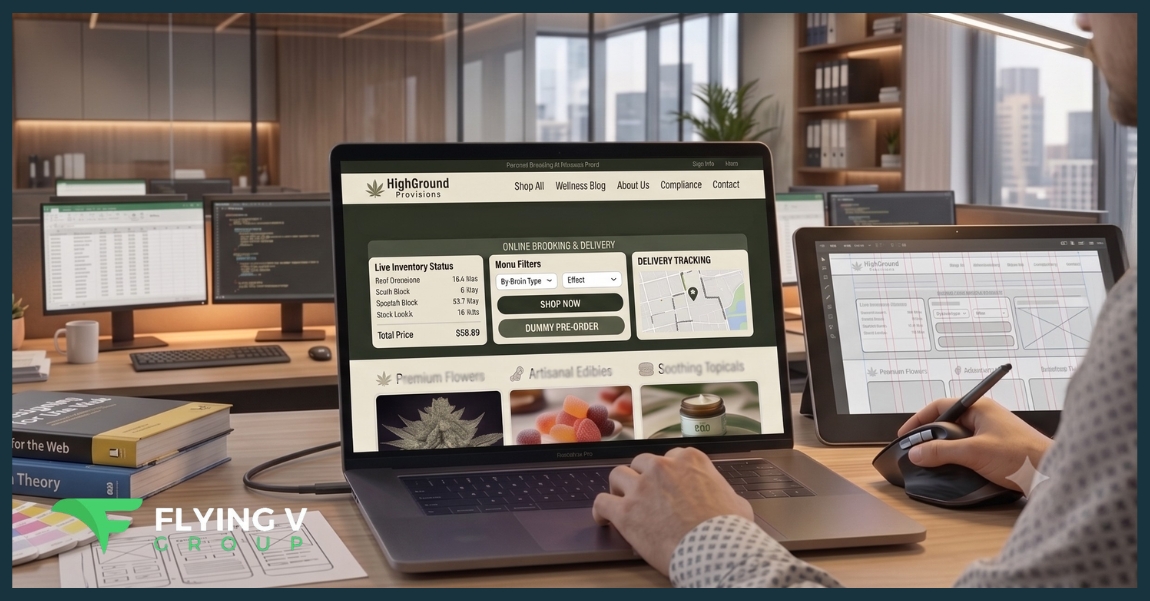
Online ordering has moved from a pandemic-era convenience to a structural revenue channel for cannabis retail. Flowhub’s 2026 retail trends data shows that 25% of all cannabis sales now happen through digital ordering, and online customers average a $68.01 order value versus $50.56 for walk-in transactions. SAMHSA’s 2024 National Survey on Drug Use and Health confirms 44.3 million Americans use cannabis monthly, a consumer base that increasingly expects the same digital-first purchasing experience they get from every other retail category.
A dispensary website built to capture that demand is not a standard ecommerce project. It requires compliance architecture, payment infrastructure specific to cannabis, and technical foundations that most generic web platforms do not support out of the box.
Flying V Group builds custom dispensary websites and SEO strategies designed for the specific constraints and opportunities of cannabis retail. Contact us to discuss what a custom build looks like for your operation.
Why Generic Ecommerce Platforms Fail Dispensaries
The Compliance Gap
Standard ecommerce platforms are not built for purchase limit enforcement. Most U.S. states cap the amount a single customer can purchase in a single transaction: one ounce of flower in California, 28 grams of usable cannabis in Washington, one ounce in Colorado. These limits must be enforced at the cart level, in real time, cross-referenced against the POS. A Shopify or WooCommerce build without custom middleware cannot do this reliably.
Age verification is the second structural gap. Asking a visitor to click “Yes, I’m 21” satisfies the visual requirement but not the compliance one in states with audience composition rules. California requires that at least 71.6% of any audience reached by cannabis marketing be reasonably expected to be 21 or older. Consent-capture forms, retargeting pixels, and email opt-ins embedded in the website all carry that requirement, not just the homepage gate.
The Payment Infrastructure Problem
Standard payment processors do not service THC-dispensing businesses. Stripe, PayPal, Square, and Shopify Payments all prohibit cannabis merchant accounts. The functional payment stack for a dispensary in 2026 runs on ACH-based processors: Aeropay, Hypur, CanPay, and Paytender. Each integrates differently. Each has a different checkout UX. Flowhub transaction data shows that integrated digital payments produce an average order value of $93.50, versus $50.56 for cash, which means designing checkout around the right processor is a direct revenue decision.
The Architecture of a High-Converting Dispensary Website
Product Catalog and Ordering Flow
The most consequential design decision for online ordering is whether the product catalog is built natively on the dispensary’s domain or embedded through a third-party iframe. An iframe renders the entire menu inside a sandboxed frame that Google’s crawler cannot index. No product pages, no strain pages, no category pages appear in organic search.
A native or API-integrated catalog creates a unique, crawlable URL for every product. Each URL can rank for specific strain names, product types, and category queries. Since IRS Section 280E disallows cannabis businesses from deducting standard marketing expenses, organic search traffic generated by indexable product pages compounds permanently without additional cost. That structural advantage does not exist for iframe-dependent menus regardless of how well-designed the rest of the site is.
POS Integration and Real-Time Inventory
A dispensary website showing products that are out of stock generates abandoned carts and eroded trust. Real-time inventory sync between the dispensary’s POS and the website is not a premium feature — it is the baseline requirement for a functional online ordering system.
The integration method matters as much as whether it exists at all. API-level integrations update inventory in near real-time. Batch sync integrations update on a schedule, often creating a window where the website shows available inventory that the store has already sold. For dispensaries running daily promotions or high-velocity SKUs like pre-rolls, a 15-minute inventory lag translates directly into cancelled orders and customer service overhead.
Mobile UX and Google’s Mobile-First Standards
According to Google’s mobile-first indexing documentation, Google predominantly uses the mobile version of a site for indexing and ranking. For dispensaries, where the majority of shoppers arrive on smartphones, mobile UX is simultaneously a ranking signal and a conversion variable.
Specific design requirements for mobile dispensary ordering:
- Product filter controls sized for touch (minimum 44px tap targets per WCAG standards)
- Cart accessible from any product page without navigating away
- Checkout flow completing in three taps or fewer from product to order confirmation
- Strain and terpene information accessible without leaving the product listing
- Address autocomplete integrated into the delivery flow
A checkout that requires six steps on mobile to complete an order loses customers to a competitor’s one-tap reorder. Flowhub data shows that digital carts are consistently 44% larger than physical ones, but only when the ordering experience works.
Accessibility: The Compliance Layer Most Dispensaries Ignore
No competitor article in this category mentions accessibility. It is a real legal exposure.
ADA.gov’s guidance on web accessibility states that businesses must ensure their websites are accessible to people with disabilities as a requirement of the Americans with Disabilities Act. The technical standard is WCAG 2.1 Level AA, published by the W3C. For cannabis dispensaries serving the general public, the ADA’s public accommodation obligations apply to the digital storefront the same way they apply to the physical one.
Practical accessibility requirements for dispensary websites include:
- Alt text on all product photography and strain images
- Sufficient colour contrast ratios for text on cannabis-branded dark backgrounds
- Keyboard navigation through the product catalog and checkout flow
- Screen-reader-compatible age verification gates that do not trap assistive technology users
- Form labels on all checkout and contact fields
A dispensary that has invested in a premium custom design but ships with inaccessible product pages faces ADA litigation risk. This is not a theoretical risk — website accessibility lawsuits have targeted retail businesses consistently since 2018, and cannabis dispensaries as brick-and-mortar retailers with digital storefronts fall squarely within the relevant case law.
SEO Architecture for Product Discovery
Crawlable Pages as the Foundation
A custom dispensary website with API-integrated menus and crawlable product pages creates an SEO foundation that a template or iframe build cannot replicate. Research published in 2025 confirmed that generative AI engines favour businesses with clearly attributed, entity-specific content over those relying on unstructured or dynamically rendered content. The same principle applies to Google: structured, crawlable pages with consistent metadata outperform dynamically rendered menu embeds.
Location Pages for Multi-Location Operators
Multi-location dispensaries need a distinct page architecture for each location. A single homepage with a store selector does not generate local organic visibility for each site. Each location needs its own URL, its own title and meta description, its own Google Business Profile integration, and its own locally relevant content.
| Location Page Element | Why It Matters |
| Unique URL per location | Allows each location to rank independently |
| Location-specific H1 | Captures “dispensary [city]” queries |
| Embedded Google Map | Supports Map Pack ranking signals |
| Location-specific hours and menu | Prevents NAP inconsistency errors |
| State-specific compliance disclosures | Meets per-state legal requirements |
A multi-state operator with six locations that routes all traffic through a single domain without location subpages is surrendering organic visibility in five of those six markets.
Build a Dispensary Website That Converts
A custom dispensary website designed for online ordering is the single highest-leverage digital asset available to a cannabis operator in an environment where paid advertising is structurally unavailable. It generates organic traffic, captures online orders at a 35% premium over walk-in transactions, and builds a first-party customer relationship that OTA platforms and directories cannot replicate.
Flying V Group builds custom dispensary websites, SEO, GEO, and content marketing strategies for cannabis operators that generate consistent inbound pipeline. Contact us to discuss what a custom build looks like for your dispensary.
Frequently Asked Questions
What makes a custom dispensary website different from a template build?
A custom dispensary website is built to the specific compliance requirements, POS stack, and ordering flow of a single operator. The most significant difference is menu integration: custom builds connect via API to create crawlable, indexable product pages, while template builds typically embed menus through iframes invisible to Google. For a cannabis business where organic search is the primary acquisition channel, that distinction directly affects revenue.
How does online ordering work on a dispensary website?
Online ordering routes customer selections through a menu integration connected to the dispensary’s POS, which updates inventory in real time, enforces state purchase limits at the cart level, and confirms availability before checkout completes. Payment processes through an ACH-based cannabis-compatible processor. The entire flow requires compliance architecture that standard ecommerce platforms do not provide by default.
What payment options can a cannabis dispensary website offer?
THC-dispensing businesses cannot use Stripe, PayPal, Square, or Shopify Payments. The functional options are ACH-based processors including Aeropay, Hypur, CanPay, and Paytender. Flowhub transaction data shows integrated digital payments correlate with a $93.50 average order value versus $50.56 for cash customers.
Does a dispensary website need to meet accessibility standards?
Yes. ADA.gov’s guidance states that businesses providing goods and services to the public must ensure their websites are accessible under the Americans with Disabilities Act, with WCAG 2.1 Level AA as the technical standard. For dispensaries this means accessible product pages, compliant age verification gates, sufficient colour contrast, and keyboard-navigable checkout flows.
How should a multi-location dispensary structure its website?
Each location needs a dedicated page with a unique URL, location-specific title and meta description, embedded map, distinct hours and menu, and state-specific compliance disclosures. A single homepage with a store selector does not generate organic search visibility for individual locations, leaving most markets without independent ranking potential.
How long does it take to build a custom dispensary website?
Custom builds typically take 8 to 16 weeks depending on the number of locations, POS integration complexity, payment processor setup, and content production requirements. Operators with a confirmed launch date should begin at least 12 weeks out to allow time for integration testing, compliance review, and pre-launch SEO configuration.
Why is organic search so important for dispensary websites?
Google’s advertising policies prohibit paid cannabis product promotion, and IRS Section 280E disallows deducting marketing expenses including paid media spend. Organic search is the primary scalable acquisition channel that generates traffic without per-click costs and without incurring the tax penalty that paid campaigns carry, making the website itself the most valuable marketing asset a dispensary owns.