
Cybersecurity companies operate in a search environment with higher trust requirements than almost any other B2B category. Prospective buyers evaluating managed detection and response, penetration testing, or incident response services aren’t making low-stakes decisions. They’re evaluating which vendor to trust with the security of critical infrastructure, and Google’s ranking systems reflect that scrutiny.
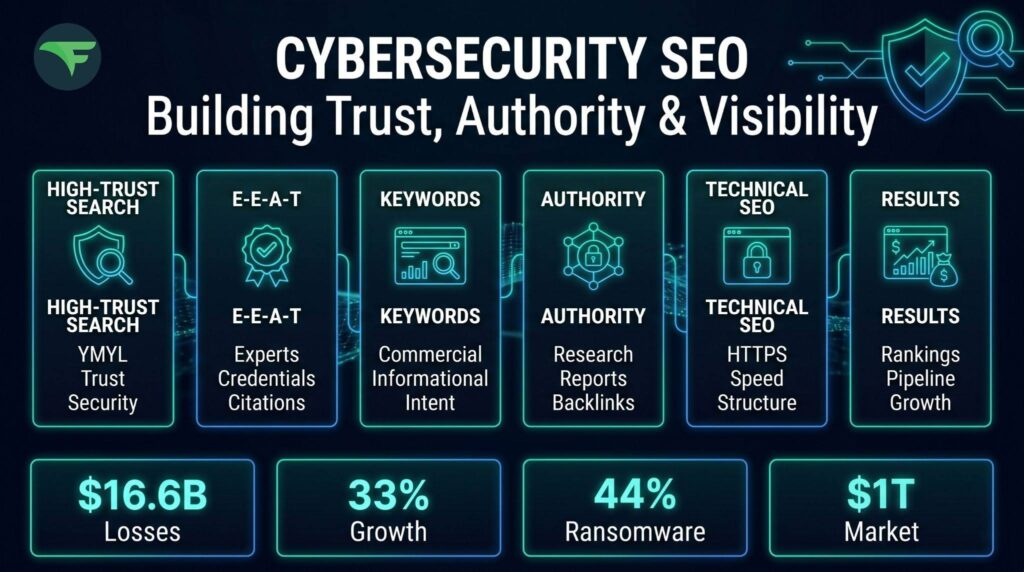
The FBI’s Internet Crime Complaint Center reported $16.6 billion in cybercrime losses in 2024, a 33% increase over the prior year. Demand for cybersecurity services has never been higher, and Cybersecurity Ventures projects global spending on cybersecurity products and services to reach $1 trillion annually by 2031. Every cybersecurity company competing for that market starts with the same challenge: visibility in search results that a sophisticated, skeptical buyer will actually trust.
Building Visibility in a High-Trust Search Category
Flying V Group’s SEO services are built for verticals where trust and technical authority drive conversions, not just traffic. If your cybersecurity company ranks for the right terms but fails to convert those visitors into a qualified pipeline, the problem is usually deeper than keywords.
Why Cybersecurity SEO Is Different From Standard B2B Marketing
Cybersecurity content sits in Google’s “Your Money or Your Life” category alongside healthcare, legal, and financial services. That classification carries real ranking consequences. CISA describes cybersecurity as critical infrastructure protection, and Google’s quality raters apply that same high-stakes lens when evaluating cybersecurity content. Pages that rank for commercial cybersecurity terms need to demonstrate genuine expertise and credibility signals that generic B2B content doesn’t require.
The buyer is also different. A CMO evaluating marketing software moves quickly. A CISO evaluating a managed security service provider conducts months of research, involves procurement, legal, and IT stakeholders, and reads technical documentation before making first contact. Cybersecurity SEO needs to serve that extended evaluation cycle across every stage.
The E-E-A-T Checklist That Actually Moves Rankings
Google’s helpful content guidance places particular weight on Experience, Expertise, Authoritativeness, and Trustworthiness for high-stakes topics. For cybersecurity websites, those signals translate into specific page-level requirements.
Author bios should include industry certifications such as CISSP, CISM, or CEH alongside verifiable professional history. Content should cite authoritative sources, including CISA guidance, Verizon DBIR findings, and FBI IC3 data, rather than relying on unattributed statistics. Case studies need specific outcomes and ideally named clients. Methodology pages that explain how services are delivered outperform generic capability claims in both trust signals and long-tail keyword coverage.
Keyword Strategy for Cybersecurity Companies
Cybersecurity keywords separate cleanly by intent. Informational terms like “what is zero trust security” or “ransomware prevention best practices” attract researchers at the top of the funnel. Commercial terms like “managed detection and response services,” “SOC as a Service,” “penetration testing company,” and “incident response retainer” attract buyers who are actively evaluating vendors. Most cybersecurity SEO programs underweight the commercial tier, where conversion rates and revenue per acquired customer are highest.
The other common mistake is treating keyword strategy as a one-time exercise. Cybersecurity search demand evolves in direct response to threat trends, making ongoing research essential for maintaining relevance.
Using Threat Intelligence Reports to Get Ahead of Keyword Demand
Verizon’s 2025 Data Breach Investigations Report analyzed over 22,000 security incidents and found that 44% of breaches involved ransomware, a jump of 12 percentage points from the prior year. When a threat category spikes in Verizon DBIR or IBM X-Force data, it typically precedes a corresponding surge in commercial search volume for related services. Cybersecurity companies that publish content addressing emerging attack vectors before competitors do earn both early rankings and strong backlink profiles as the topic gains traction.
Content That Builds Authority in Cybersecurity
Content marketing for cybersecurity companies needs to function as proof of expertise, not just demand generation. A blog post explaining “how ransomware works” satisfies informational intent. A detailed analysis of a specific ransomware campaign with indicators of compromise, attack chain documentation, and remediation guidance demonstrates the depth of knowledge that earns both rankings and inbound links from the security community.
The highest-value content formats for cybersecurity SEO are original threat research, vulnerability disclosures, annual security reports, and technical case studies with specific outcomes. These formats attract links from industry publications, earn citations in academic research, and generate the kind of topical authority that raises domain-wide rankings across your entire keyword footprint.
Why Backlink Acquisition Looks Different in This Vertical
Cybersecurity companies earn backlinks through a fundamentally different mechanism than most B2B industries. Security researchers, journalists covering breaches, and incident responders cite sources that provide original intelligence, not editorial opinions.
Publishing original CVE findings, building free security tools, releasing annual threat reports, and contributing to industry surveys creates the kind of content that earns unsolicited citations from high-authority domains in the security community. Partnerships and outreach matter, but they accelerate what original research makes possible.
Technical SEO and Trust Infrastructure
Technical SEO for cybersecurity websites carries an additional layer of importance beyond standard performance requirements. HTTPS is baseline, but security headers, clean server configurations, and evidence of active maintenance all contribute to the trust signals search engines use to evaluate site credibility. A cybersecurity firm with a slow, technically inconsistent website creates an immediate credibility gap for any buyer conducting due diligence.
Site architecture should reflect how buyers actually research cybersecurity decisions. Separate service pages for each distinct offering, sector-specific pages for the industries you serve, and methodology documentation give search engines the structured content they need to attribute topical authority and serve your pages for appropriate commercial queries.
Author Credentials as a Ranking Signal
For cybersecurity content, author attribution is not optional. Author bios linked to professional profiles and industry credentials serve a dual function: they satisfy Google’s E-E-A-T requirements for high-stakes content and they reduce buyer skepticism during the research phase. A technical blog post attributed to a CISSP-certified practitioner with a verifiable LinkedIn profile and conference speaking history ranks and converts differently than the same content published anonymously.
How Cybersecurity Buyers Research Before Contacting Your Sales Team
Enterprise cybersecurity procurement involves multiple stakeholders and extended evaluation timelines. Gartner’s research on enterprise software buying consistently shows that buyers complete a significant portion of their evaluation process through self-directed digital research before engaging any vendor. For cybersecurity, where procurement involves security, IT, legal, and compliance teams simultaneously, that window extends further than most categories.
Search visibility across the full research cycle, from early-stage threat awareness to vendor comparison, positions your firm at multiple points in a buying process that competitors who focus only on commercial terms will miss. The companies that rank for both “what is managed detection and response” and “MDR services pricing” are visible throughout a buyer’s evaluation rather than only at the end.
| Company Stage | Typical Monthly SEO Investment |
| Startup / Series A | $2,000 to $5,000 |
| Mid-market | $5,000 to $12,000 |
| Enterprise / MSSP | $12,000 to $30,000+ |
Putting It Into Practice
Cybersecurity SEO compounds when the core elements work together: authoritative content that earns links, technical infrastructure that signals trust, and keyword targeting that serves commercial buyers across their full evaluation cycle. The generative engine optimisation layer adds a further requirement — structuring content so AI tools including Google AI Overviews and Perplexity can cite it when security buyers use AI in their research.
If your cybersecurity company’s organic search presence isn’t generating a qualified pipeline at a volume that reflects the growth in market demand, contact Flying V Group to see what a strategy built around this vertical’s specific trust and authority requirements looks like.
Frequently Asked Questions
What is cybersecurity SEO?
Cybersecurity SEO is the practice of optimising a cybersecurity company’s search visibility through technical infrastructure, E-E-A-T-compliant content, strategic keyword targeting, and authority-building link acquisition. Because cybersecurity falls into Google’s high-trust content category, the discipline requires stronger credibility signals than most B2B industries, including author credentials, cited threat intelligence, and original research.
Why do cybersecurity companies struggle with SEO?
Most cybersecurity companies under-invest in E-E-A-T signals, publish content that addresses informational intent without targeting commercial keywords, and lack the original threat research or tools that attract backlinks from high-authority security publications. The result is visibility among researchers but not among buyers actively evaluating vendors.
How long does cybersecurity SEO take to produce results?
Most cybersecurity SEO campaigns produce measurable ranking movement within three to four months and qualified pipeline contributions by months six through nine. Competitive terms like “managed security services” or “penetration testing company” may take longer in dense markets. Content targeting mid-funnel informational queries often ranks faster and generates early authority while commercial rankings develop.
What keywords convert best for cybersecurity companies?
Commercial-intent keywords tied to specific services convert at the highest rates: managed detection and response, SOC as a Service, incident response retainer, penetration testing company, and cloud security assessment. These terms attract buyers who are actively evaluating vendors rather than learning about a threat category.
How do cybersecurity companies earn backlinks?
Original threat research, vulnerability disclosures, free security tools, annual threat reports, and industry survey data attract the most authoritative inbound links in cybersecurity. Publications covering security news, academic researchers, and incident responders cite primary sources, making original intelligence the most effective link acquisition strategy in this vertical.
Does local SEO matter for cybersecurity companies?
It depends on the business model. MSSPs and consultancies serving specific geographic markets benefit substantially from local SEO and Google Business Profile optimisation. Enterprise cybersecurity vendors selling nationally or globally typically prioritise organic and topical authority over local pack visibility, though local signals can still contribute to credibility in target markets.
What makes a cybersecurity SEO agency qualified to work in this vertical?
Look for demonstrated experience producing content that cites primary security sources such as CISA, Verizon DBIR, and FBI IC3. Ask whether the agency understands the difference between informational and commercial keyword intent in security, how they approach E-E-A-T for high-trust content, and whether they can show pipeline attribution from organic search for a cybersecurity or comparable high-trust B2B client.