

Social media management in Orange County can be quoted at $2,000 a month by one agency and $6,000 by another, and both prices can be fair. The gap usually comes from scope rather than markup: who creates the content, how much video is involved, whether paid social is included, and how many people touch each post.
No authoritative “Orange County rate” exists, and quotes built on vague packages are hard to compare. The more useful skill is reading a proposal line by line so you know what each dollar buys.
What follows breaks down how a social media management price gets built, which costs often sit outside the retainer, and how to compare quotes fairly. Flying V Group, based in Newport Beach, prices every engagement this way, and the same method works on any proposal you receive.
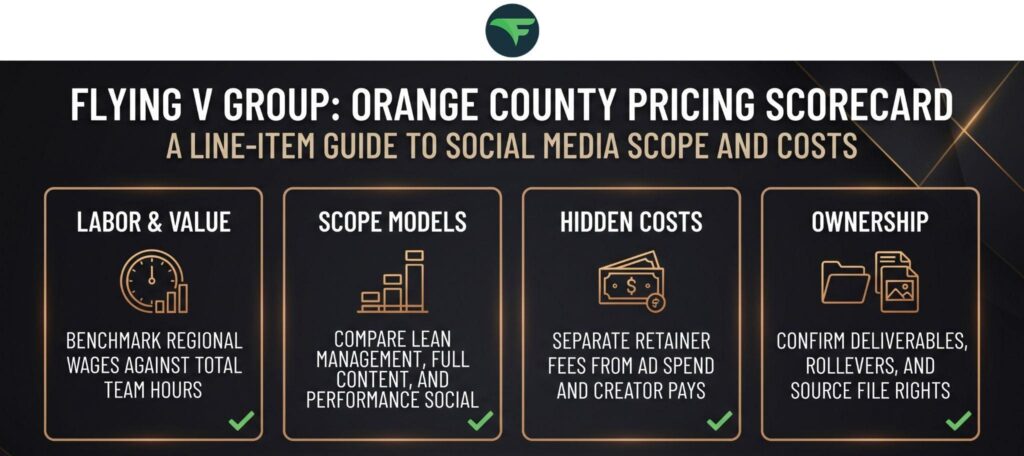
What Labor Costs Look Like in Southern California
Most of a social media fee pays for people’s time, so labor costs are the right benchmark. Private-industry employers in the Los Angeles-Long Beach area, which includes Orange County, paid an average of $51.38 per hour worked in March 2026, including $16.38 in benefits, according to BLS metro compensation data.
Professional roles run higher. Management and professional workers nationally earned $54.06 per hour in wages in June 2026, and adding the benefit categories in the BLS occupational breakdown brings total employer cost to roughly $78.88 per hour. Keep both figures in mind when a quote seems high or suspiciously low.
Management vs. Content Production
Social media management covers strategy, the content calendar, scheduling, community management, social listening, reporting, and client communication. Content production covers copywriting, graphic design, photography, videography, short-form editing, and UGC coordination.
Proposals often blend the two under one label. A business that supplies professional photos and video every month needs far less production scope than one expecting the agency to shoot everything, and the price should reflect that difference.
What Drives the Price
Every quote is a sum of scope decisions. The table shows how each one pushes an engagement lighter or heavier.
| Scope Variable | Lighter Engagement | Heavier Engagement |
| Platforms | 1 to 2, shared content | Several, each with its own strategy |
| Creative assets | Client-supplied | Original agency shoots |
| Video | Minimal | Regular short-form production |
| Copy | Basic captions | Research-heavy or expert content |
| Community management | Limited weekday replies | Daily comments, DMs, escalation |
| Paid social | None | Campaign management and testing |
| Approvals | One decision-maker | Multiple stakeholders or legal review |
| Reporting | Platform metrics | Attribution and recommendations |
What Goes Into a Single Post
A 30-second Reel rarely starts with the camera. It moves through concept, research, script, client approval, filming, editing, on-screen text, caption copy, brand or claim review, scheduling, comment monitoring, and performance analysis.
You are paying for that chain, not the moment someone clicks “publish.” A carousel follows a shorter path, but it still needs topic selection, copy, design, revisions, approval, and reporting.
Why Cost per Post Misleads
Picture a hypothetical Agency A charging $2,000 for 20 posts, or $100 each, and Agency B charging $3,000 for 12 posts, or $250 each. Agency A looks cheaper until you learn its posts are stock images with captions, while Agency B’s include original filming, editing, community management, and analytics.
Compare scope, creative quality, strategy, management time, and measurement instead of dividing the fee by the post count.
Three Scope Models
These are not standardized industry packages. They are a practical way to see how scope expands and why prices rise with it.
Lean Management
The client supplies most assets. The agency handles strategy, the calendar, copy, light design, publishing, basic community management, and reporting.
Full Content Management
The agency creates the content as well as managing it: original design, short-form editing, platform-specific creative, daily community management, and ongoing optimization.
Performance Social
This model adds paid social, creative testing, conversion tracking, creator or UGC campaigns, landing page coordination, and lead or revenue measurement. Tracking work may also bring privacy configuration into scope, so confirm who owns it.
Fees That Sit Outside the Retainer
A monthly management fee pays the team. Several other costs can appear on top of it, and the most common confusion involves ad spend on paid social campaigns.
| Cost | Usually Included? | Question to Ask |
| Ad spend | No, paid to platforms | Whose card is billed? |
| Creator compensation | Often separate | Who negotiates and pays? |
| Photo and video shoots | Varies | How many per quarter? |
| Software and reporting tools | Varies | Passed through or absorbed? |
| Travel and on-location work | Often separate | Is there a mileage or day rate? |
Orange County Geography Changes Production Scope
Location affects price only through the work it creates. A B2B firm in one Irvine office with a national audience may need no on-site shoots at all.
A restaurant group with locations in Newport Beach, Costa Mesa, and Huntington Beach might need recurring filming at each site, event coverage, and location-specific posts. Same county, very different production calendars.
Freelancer, In-House, or Agency
A freelancer fits when you need one specialist, such as an editor or designer, and already handle strategy internally. An in-house hire fits when social is central enough to justify dedicated staff and you can support that person with design, video, and paid media resources.
An agency fits when you need several capabilities without building each one internally. At Flying V Group, our social media marketing teams pair strategists with a content creation workflow, and clients who prefer to build internally can hire through our staffing arm.
Compare Total Cost, Not Salary
Benefits made up 30.0% of private-industry compensation costs in June 2026, and full-time private workers cost employers $54.00 per hour worked, according to the BLS Employer Costs for Employee Compensation release. Compare an agency retainer against that full cost, plus the tools and extra skills one hire cannot cover alone.
Scope Questions to Ask Before Signing
Ask who writes captions, creates graphics, and films video, how many edited videos are included, and how many revision rounds each piece gets. Confirm whether Stories count as deliverables, what hours community management covers, and whether crisis escalation is part of it.
Then settle the money and ownership questions: whether paid social and creator outreach are included, who builds ad creative, whether unused deliverables roll over, and who keeps raw footage and source files if the contract ends.
Pricing a Program That Fits
A fair Orange County quote names every deliverable, separates management from production, lists costs outside the retainer, and ties scope to the work your business needs. Once a proposal is broken down that way, comparing two agencies becomes a straightforward exercise.
Flying V Group builds line-item scopes for Orange County businesses, from lean management to full performance social. Request a scoped proposal from our team and see exactly what each part of the fee covers.
Frequently Asked Questions
How much does social media management cost in Orange County?
No authoritative standardized rate exists for Orange County social media management, because price depends almost entirely on scope. Ask every agency for a line-item quote so you can compare deliverables, production, and management time directly.
Is influencer management usually included in social media management?
Influencer management is usually a separate scope item because it involves sourcing, briefing, approvals, and ongoing monitoring. The FTC’s Endorsement Guides FAQ says there is no one-size-fits-all monitoring standard and suggests pre-approving posts when regular monitoring is impractical, and either approach takes staff time.
Should I pay per post or a monthly retainer?
Monthly retainers suit ongoing management, because community replies, reporting, and strategy don’t map neatly to individual posts. Per-post pricing can work for short, production-only projects with a fixed deliverable count.
Do unused deliverables roll over to the next month?
Rollover policies vary by agency, and many retainers do not carry unused posts forward by default. Negotiate this before signing, especially if your approvals tend to run slow.
How much should a small business spend on social media management?
The right budget follows your goals and internal resources rather than a fixed percentage. A business supplying its own photos and approving quickly can often run a lean scope, while one needing video, paid social, and daily engagement should plan for a larger investment.
Is hiring one in-house marketer cheaper than an agency?
One in-house marketer can cost less on paper, but that person rarely covers strategy, design, video, and paid media alone. Market research analysts and marketing specialists averaged $43.03 an hour, or $89,490 a year, before benefits in May 2025, according to BLS occupational wage data.
Do Instagram Stories count as deliverables?
Some agencies count Stories as deliverables and others treat them as extras or leave them out. Confirm how many Stories are included each week and whether they are original or repurposed from feed posts.