
Plastic surgeon SEO succeeds when it turns procedure research into consultation requests, not when it ranks a practice for “plastic surgeon” plus a city name. A prospective patient searches dozens of questions about cost, candidacy, recovery, and risk before contacting anyone, and each unanswered question is a reason to keep looking elsewhere.
Most cosmetic practices invest in rankings and traffic, then wonder why inquiries lag. The gap is usually content that stops short of what a serious patient needs to know before picking up the phone.
Below is how to build organic visibility around the full procedure decision, which content moves patients toward a consultation, and how to measure SEO by booked procedures. Flying V Group builds medical SEO programs on this approach, starting with the procedures a practice most wants to grow.
Where Procedure Demand Stands in 2025
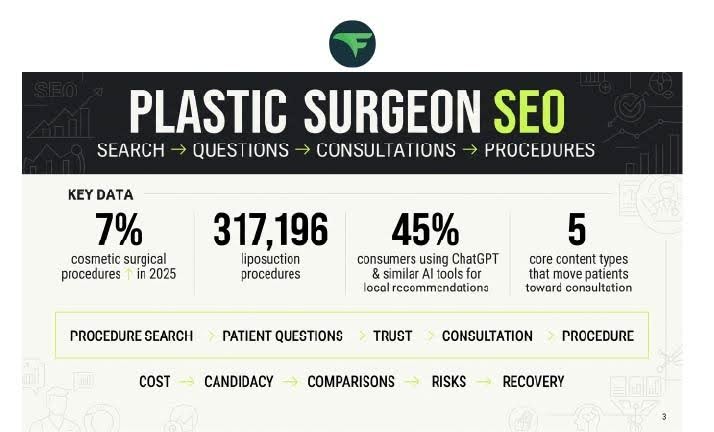
Cosmetic surgical procedures rose 7% in 2025, according to the American Society of Plastic Surgeons. Liposuction remained the top procedure at 317,196, while breast augmentation and implant revision reached 304,234, up 11%.
Breast lifts climbed 8% to 156,131, eyelid surgery jumped 19% to 118,978, and facial fat grafting posted the largest gain at 39%. Compare those trends against keyword volumes and the procedures your surgeon most wants to perform before setting content priorities.
Optimize Around Procedures, Not “Plastic Surgeon [City]”
“Plastic surgeon near me” searches matter, but they capture patients at the very end of a long research process. Breast augmentation alone spans searches for implant types, sizes, cost, scars, recovery, risks, results after breastfeeding, and comparisons with a breast lift.
The goal is to own the questions patients ask between first interest and choosing a surgeon. A practice that answers those questions well gets considered before the patient ever searches for a provider by name.
Every Search Hides a Question
Many procedure searches are objections in disguise. Each one tells you what stands between the patient and an inquiry.
| Search | The Question Behind It |
| tummy tuck cost | Can I afford this? |
| tummy tuck scar | Is the tradeoff worth it? |
| tummy tuck recovery | Can this fit my life? |
| tummy tuck risks | Is this safe enough for me? |
| tummy tuck vs liposuction | Am I considering the right procedure? |
| tummy tuck after pregnancy | Am I a candidate? |
| best tummy tuck surgeon near me | Who can I trust? |
What a Procedure Page Needs
A page covering only “what it is,” “benefits,” and “why choose us” rarely competes in a medical niche. Strong procedure pages address candidacy, the consultation, technique options, incisions and scarring, anesthesia, recovery milestones, results timeline, longevity, risks, alternatives, cost factors, real results, and surgeon credentials.
Length is not the goal. Ask whether a serious patient could finish the page without returning to Google for five basic answers. Our healthcare SEO team audits procedure pages against that test, along with the on-page SEO factors that help them rank.
Content That Moves Patients Toward a Consultation
Supporting content should resolve the specific doubts that delay an inquiry. Five types do most of the work.
Cost Content
Patients searching “facelift cost” are testing feasibility, not bargain hunting. You don’t need to publish a fixed price. Explain surgeon fees, facility and anesthesia costs, combination procedures, what is included, financing options, and why quotes vary. “Contact us for pricing” leaves the biggest late-stage question unanswered.
Candidacy Content
Searches like “tummy tuck after pregnancy” or “facelift in your 50s” deserve better than “schedule a consultation to find out.” Explain what surgeons evaluate, such as health history, skin quality, weight stability, and goals, while making clear that final candidacy requires an in-person assessment.
Comparison Content
Patients comparing a breast lift with augmentation, or a mini facelift with a full facelift, already know options exist. Surgeon input adds the information gain: when one option is recommended over the other, what each cannot correct, and when procedures are combined.
Risk and Complication Content
Patients researching complications are often closer to surgery than those reading general overviews. The FDA requires a patient decision checklist for breast implants, noting that implants are not lifetime devices and that capsular contracture, reoperation, and removal are the most common local complications.
Content that explains warning signs, risk factors, and how surgeons reduce complications builds trust that “you’re in safe hands” copy cannot.
Recovery Planning Content
“Recovery takes a few weeks” doesn’t help anyone plan surgery. Patients want to know when they can drive, shower, sleep on their side, return to work, lift a child, exercise, fly, and look ready for an event. Specific timelines turn a vague interest into a scheduled consultation.
Post-Weight-Loss Body Contouring Searches
ASPS reported in its 2025 statistics release that restoration after weight loss, aging, and other life changes drove much of the year’s growth, with lift procedures leading. ASPS notes its data shows increased patient conversations but does not establish a causal link to any procedure category.
That still points to a content gap: loose skin after major weight loss, weight stability before body contouring, and lifts after significant weight loss. These topics have a clearer reason to exist than another “benefits of a tummy tuck” post.
Turn Before-and-After Photos Into Search Assets
A single gallery page with hundreds of anonymous cases wastes the most original content a practice owns. Build procedure-specific galleries, and with patient consent, give individual cases context: the patient’s concern, the approach used, implant details where relevant, and the timeline of the after photo.
Google’s image SEO guidance recommends optimizing the pages that host images, not just the files. Keep expectations realistic: the FTC’s Health Products Compliance Guidance judges marketing by its overall impression, including before-and-after imagery, a useful standard for any cosmetic practice.
Use Surgeon Expertise Competitors Can’t Copy
Generic agency copy restates the same definitions as every other result. Surgeon input creates content no competitor can replicate: what patients most often misunderstand, what makes a case complex, which unrealistic expectations come up in consultations, and what surprises patients about recovery.
Show who wrote or reviewed each page, with credentials, specialty, and an update date. Clear authorship is central to E-E-A-T, which carries extra weight for health topics.
Visibility in AI Answers
Patients increasingly research procedures through AI tools before visiting a practice website. BrightLocal’s 2026 Local Consumer Review Survey found 45% of consumers now use ChatGPT and similar AI tools for local business recommendations, up from 6% the year before.
Our answer engine optimization work, part of Flying V Group’s SEO package, structures procedure pages, FAQs, and surgeon bios so AI platforms can extract and cite them accurately. Clear facts, named medical review, and original surgeon insights give AI tools the same reasons to trust a practice that patients look for.
Local and Branded Search
Patients considering a $10,000 elective procedure will travel farther than they would for a coffee shop, so proximity alone rarely wins. Location pages should show procedures offered, surgeon credentials, the facility, results, and the consultation process, backed by the wider medical marketing program.
After discovering a surgeon, patients search the name plus “reviews,” “before and after,” or “complaints.” Audit what appears for those searches, because a strong ranking means little if the next search undermines confidence.
Track Consultations and Procedures by Source
Organic traffic and form fills only tell part of the story. Track each procedure from page visit to inquiry, qualified inquiry, booked consultation, attended consultation, booked procedure, and revenue.
| Procedure Page (Hypothetical) | Inquiries | Consults Booked | Procedures Booked |
| Breast augmentation | 42 | 21 | 9 |
| Rhinoplasty | 38 | 10 | 2 |
| Facelift | 16 | 11 | 6 |
| Tummy tuck | 31 | 20 | 10 |
In this example, rhinoplasty draws inquiries but few procedures, while facelift converts well from lower volume. When a high-traffic page produces few inquiries, check whether it covers cost, candidacy, results, credentials, and recovery, and whether the mobile form is easy to complete.
Building SEO That Fills Consultation Calendars
Plastic surgeon SEO works when each priority procedure has content that answers cost, candidacy, comparison, risk, and recovery questions, backed by real results and visible surgeon expertise, and measured by booked procedures.
Flying V Group builds procedure-level SEO programs for cosmetic practices, from content planning with surgeon input to consultation tracking. Talk with our team about growing your procedure inquiries.
Frequently Asked Questions
Should plastic surgeons publish procedure prices online?
Publishing cost factors and typical ranges helps patients judge feasibility before reaching out. ASPS includes average surgeon fees in its annual procedural statistics report, and practices can explain how facility, anesthesia, and combined procedures change the final quote.
Should surgeons write or review their own SEO content?
Surgeons should review all medical content and contribute insights from consultations wherever possible. Google’s guidance on creating helpful content places extra weight on trust for topics that affect health or safety, and named medical review supports that trust.
Should every cosmetic procedure have its own page?
Every procedure the practice wants to grow should have a dedicated page. Minor variations can live as sections within the main procedure page unless they attract distinct searches.
Do before-and-after photos help SEO?
Before-and-after photos help when they sit on procedure-specific pages with descriptive context. A single unorganized gallery offers search engines and patients very little to work with.
How long does plastic surgery SEO take to produce consultations?
Most practices see measurable movement within several months, with procedure pages ranking before broader terms. Competitive metros and newer websites usually take longer.
Why is my plastic surgery website getting traffic but no consultation requests?
Traffic without inquiries usually points to pages that skip cost, candidacy, real results, or surgeon credentials, or to a difficult mobile form. Review your highest-traffic procedure pages against the questions patients ask before booking.