
SaaS brand mentions in ChatGPT come from two separate systems, and most teams spend their budget optimizing the wrong one.
One system is retrieval: ChatGPT runs a search, pulls live pages, and links to a handful of URLs. The other is the model’s trained knowledge of your category, built long before anyone typed the prompt.
For reference: Ahrefs data puts ChatGPT at roughly 12% of Google’s search volume, while Google still sends about 190 times more referral traffic to websites. The value here is not clicks, it’s the name that surfaces when a buyer asks which tool to use.
This data means that SaaS information distribution is being split in two ways:
- ChatGPT names the brand in prose, then links to G2, Reddit, or a competitor’s comparison page
- ChatGPT cites information but not recommended: a documentation page gets linked as a source while a rival gets the endorsement
Both look like visibility in a screenshot, however, neither convert.
Closing that gap is the core of how Flying V Group approaches SEO for software companies now, and the mechanics below are the same ones our audits start with.
Mentions and Citations Are Not the Same Product
A mention is narrative. ChatGPT names your product because the model’s training data and retrieved context treat you as a real entity in a defined category. A citation is a link decision: a specific URL the model was willing to quote or paraphrase.
Mentions respond to reach and consistency: in other words how much your brand is discussed across the web.
Citations respond to whether a given page is accessible, extractable, and specific enough to quote.
In context: ChatGPT cites an average of 15 sources per response against Gemini’s three, and only 11% of domains get cited by both ChatGPT and Perplexity. Yet the engines largely name the same brands: Ahrefs measured output overlap across ChatGPT, AI Mode, and AI Overviews at 0.779. Which URLs get linked varies sharply by platform, whereas, which brands get recommended does not. Optimizing for one surface produces a partial picture of your brand’s online presence.
Why SaaS Brand Mentions in ChatGPT Fail Before the Content Does
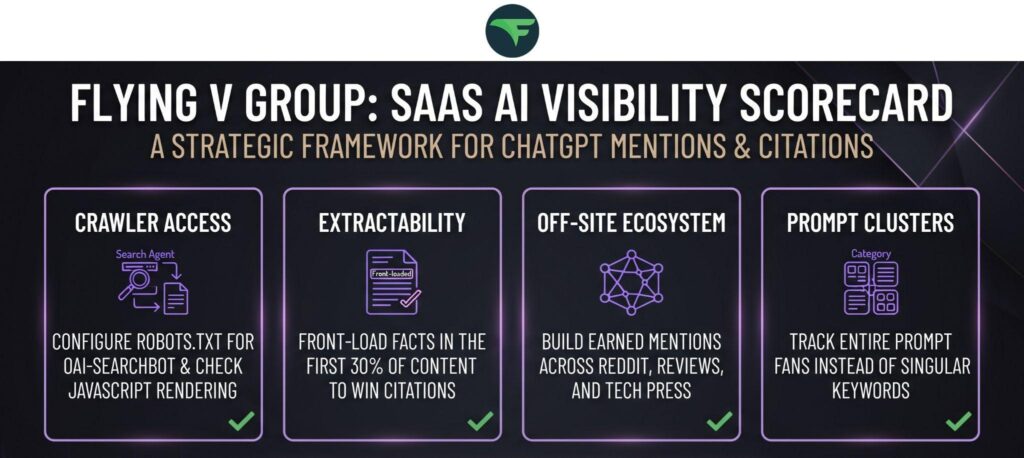
OpenAI runs three agents for three jobs: GPTBot collects training data, OAI-SearchBot builds the index ChatGPT Search retrieves from, and ChatGPT-User fetches pages live when a prompt triggers browsing.
Each is governed by its own robots.txt token, and each setting is independent. A site can allow OAI-SearchBot to appear in ChatGPT results while disallowing GPTBot to keep its content out of foundation model training.
The consequence is documented rather than inferred.
OpenAI states that sites opted out of OAI-SearchBot will not be shown in ChatGPT search answers, though they may still appear as navigational links. Blocking GPTBot alone costs you nothing in citations. Blocking the search agent removes you from the candidate pool entirely.
SaaS teams rarely do this on purpose. The failure is almost never a missing Allow line. It is a blanket disallow, a Cloudflare bot rule left on by default, a WAF filter, or a JavaScript challenge that hands back an interstitial instead of a page. Marketing blocks “AI scrapers” to protect the product docs, then wonders why the category answer skips them.
Rendering is the second gate. If your pricing, comparison, and integration pages build client-side, the raw HTML a crawler receives may hold nothing worth quoting. Check the source, not the browser view.
Off-Site Brand Mentions Outweigh On-Site Polish
The largest correlation study available makes the priority order fairly blunt. Ahrefs analyzed 75,000 brands and found branded web mentions correlate with AI Overview brand visibility at 0.664, against 0.218 for backlinks, with the three strongest signals all being off-site factors.
A December follow-up extending the analysis across ChatGPT and AI Mode found YouTube mentions correlated even more strongly, near 0.737.
For ChatGPT specifically, the finding is more useful than it first appears. ChatGPT shows the weakest correlation with classic authority metrics, with Domain Rating landing at just 0.266. A well-funded competitor with a decade of link equity does not automatically own the answer, category conversation does.
Muck Rack’s Generative Pulse analysis of more than a million AI-cited links found roughly 99% come from non-paid media, with paid and advertorial content accounting for just 0.3% of all citations.
The takeaway: review platforms, trade press, practitioner forums, and independent comparison content are doing the work that a company blog cannot do for itself.
SaaS Brand Mentions and Visibility Is a Topic Game, Not a Keyword Game
The most actionable reframe in the current research is structural. Semrush tracked 1,094 US categories monthly in ChatGPT from January through June 2026, treating each category as a cluster of five representative prompts covering definitions, comparisons, alternatives, use cases, and buying questions.
A brand qualified as category owner only by holding the highest share of mentions, appearing in at least four of five prompts, and leading the runner-up by five percentage points or more.
Read as a target definition: you are not trying to win “best project management software,” you are trying to appear across the full prompt fan for your category, including the alternatives query that names your competitors and the use-case query that never names anyone.
What Makes a Page Extractable
Placement inside a page matters as much as the page itself.
Research found 44.2% of LLM citations come from the first 30% of page content, and pages that front-load the answer rather than burying it below a scroll are the ones retrieval systems favor.
That means a direct declarative answer in the opening lines, one claim per sentence, named sources with dates, and proprietary numbers a model cannot get anywhere else.
Vague thought leadership is hard to quote. A page that states which user agent to allow and which file to edit is easy to reuse.
How Flying V Group Builds Brand Mentions Into SaaS SEO Programs
Most agencies still report rankings. We treat ChatGPT visibility as a measured channel with its own diagnostics, and the sequence matters more than the volume of work.
Diagnosis starts by scoring which prompts in a category are realistically winnable against the ones locked up by Wikipedia, Reddit, and entrenched review platforms.
From there we map the full prompt cluster a buyer actually runs, including the alternatives and comparison queries where SaaS brands lose share quietly and rarely notice. Both outputs are tracked, since citation share moves faster than rankings and a monthly report will miss the change entirely.
That data drives a three-part build. Crawler and render access gets confirmed at the log level, because no content program survives an agent that never reads the page. Owned pages are then restructured for extraction, which is cheap and applies to assets you already have.
Earned mentions come last in sequence and first in budget, aimed at the specific publications and communities ChatGPT already pulls from in your category.
We have run versions of this for software, professional services, and e-commerce clients, and our case studies tend to show the same shape: access fixes land quickly, and mention-driven views compound over time.
If your SaaS brand appears in AI answers inconsistently, or competitors get named where you do not, our content and SEO team can run a category-level visibility audit and identify which of the two systems is failing. Get in touch and we will start with your prompt fan rather than your keyword list.
Frequently Asked Questions
Does our own content still matter if most citations are third-party?
Yes, for a different reason. Third-party sources drive whether ChatGPT knows and trusts your brand. Your own pages determine what gets quoted once retrieval reaches you, which is where you control the framing, the pricing detail, and the comparison logic. Owned content also feeds the review sites and journalists who become the citable third parties.
How are brand mentions measured without guessing?
Track four things weekly across a fixed prompt set: mention rate, position within the answer, sentiment, and which third-party URLs get cited. Weekly cadence matters because citation share shifts faster than rankings do. Server logs confirm that OAI-SearchBot and ChatGPT-User are reaching your pages, but logs alone never tell you whether an answer actually named you.
How long before a SaaS brand starts showing up in ChatGPT answers?
Access fixes move fastest. Once robots.txt and rendering issues are resolved, expect retrieval-driven changes within 8 to 12 weeks. Mention-driven changes, meaning ChatGPT naming you in the answer text rather than linking a page, typically take 4 to 6 months because they depend on third-party coverage accumulating.
Can I pay for placement in ChatGPT answers?
No. Muck Rack’s analysis of over a million AI-cited links found paid and advertorial content accounts for just 0.3% of citations, with roughly 99% coming from non-paid media. Sponsored placement in a publication AI systems already cite can help indirectly, but the citation goes to the publication’s editorial credibility, not to the spend behind it.
One finding worth considering for the mentions section: the report says how-to and comparative queries lean on reference and brand-owned content, while industry trend queries cite journalism in 46% of responses, more than double the rate. That maps directly onto the commercial-intent point already in that section and gives SaaS readers a reason to invest in their own comparison pages rather than treating earned media as the only lever.