Choosing the right organic SEO expert in 2026 is a different decision than it was two years ago.
AI Overviews are compressing click-through rates on informational queries. Zero-click searches now account for more than half of all Google results. AI referral traffic grew more than sevenfold year-over-year in 2025 as ChatGPT, Perplexity, and Gemini established themselves as real discovery channels alongside traditional search.
Organic search specialists worth hiring understand both systems and build for both simultaneously.
The market has split into two categories. The first: consultants who go deep on a single discipline, whether technical audits, link building, or content strategy. The second is practitioners who build visibility across both traditional search and AI-driven platforms simultaneously. An audit that identifies content gaps does not produce content.
Link building that earns DA 50+ placements does not automatically map those gains to your conversion keywords. For businesses that need organic search to build a qualified pipeline, the second category offers the most leverage.
The seven experts below represent the strongest options across both categories. If you are benchmarking what organic SEO consulting looks like when tied directly to revenue outcomes, Sean Fulford’s approach at Flying V Group is worth reviewing first.
How We Evaluated These Experts
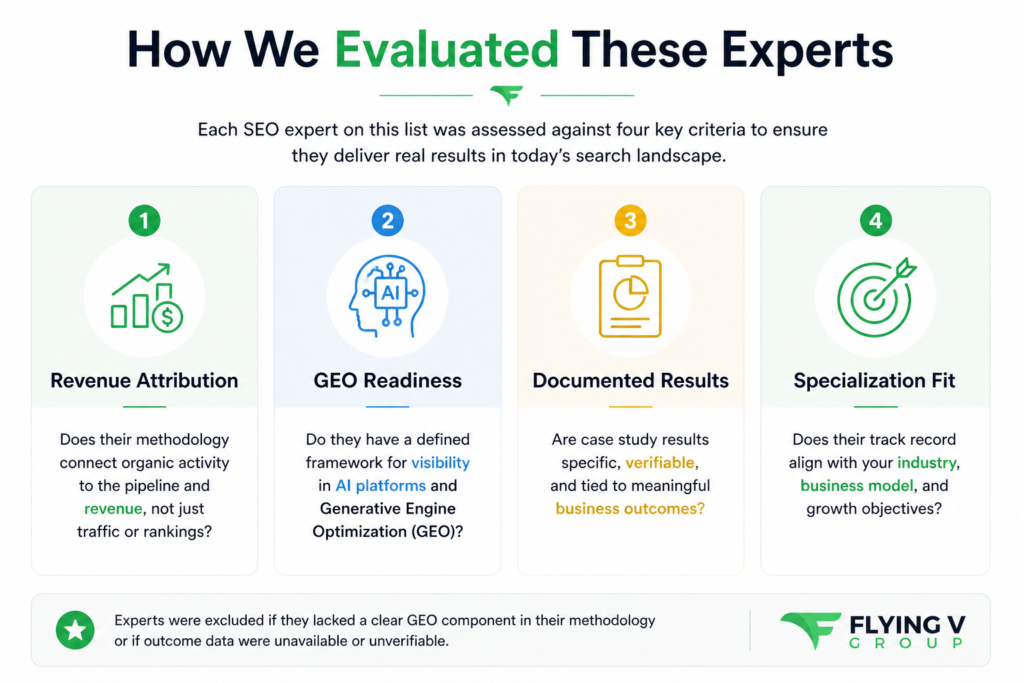
Each practitioner on this list was assessed against four criteria:
- Revenue attribution: Does their methodology connect organic activity to the pipeline, not just traffic?
- GEO readiness: Do they have a defined framework for AI platform visibility?
- Documented outcomes: Are case study results specific and verifiable?
- Specialization fit: Does their track record match the business models most likely to hire them?
Practitioners were excluded if their public methodology did not include a GEO component or if outcome data were unavailable or unverifiable. Rankings reflect overall capability and depth of revenue-focused SEO practice.
1. Sean Fulford — Organic SEO and GEO Built for Revenue, Not Rankings
Best For: Growth-stage businesses and professional services firms that need organic SEO tied directly to P&L outcomes, not only traffic reports.
Sean Fulford has spent more than 8 years building organic search programs for clients ranging from regional SMBs to Fortune 500 companies. As Director of SEO and Senior SEO Solutions Architect at Flying V Group, his core premise is one most organic SEO consultants skip: rankings that do not connect to the pipeline are a distraction, not an asset.
Sean’s client roster includes Bain Consulting and John Hancock. Flying V Group was recognized as the eighth-fastest-growing company in Orange County by the Los Angeles Times, a trajectory that his organic programs have directly contributed to across 400+ client engagements. His work has also been verified through Clutch, where FVG holds a strong review record across SEO and content engagements.
Core Capabilities:
- Full-stack organic SEO: technical audits, keyword architecture, on-page optimization, and authority building under one engagement
- Generative Engine Optimization (GEO) targeting visibility in AI-driven environments, including ChatGPT, Perplexity, and Google AI Overviews
- Content at scale: 1,000+ pieces per month calibrated to both traditional search intent and LLM citation pathways
- Organic link building with DA 50+ placements as standard
- Revenue-model audit that maps organic search activity to actual pipeline contribution before execution begins
Sean’s Technical Approach
Sean’s GEO framework runs on three infrastructure layers inside his proprietary GEO Genius toolset:
Citation Velocity: how quickly a brand earns mentions across AI-indexed sources.
Query Fanout Simulation: mapping how LLMs expand a single search into related queries,
LM Discoverability: ensuring content is structured for AI retrieval, not just Google crawling.
Clients end up ranking in traditional search and being cited by the AI platforms their buyers already use.
Why Sean’s Approach Is Different
Sean starts every engagement with a revenue-model audit before any execution begins. He maps existing organic traffic to actual pipeline contribution.
In several professional services engagements, the audit revealed that the majority of organic sessions were arriving from informational keywords with no commercial intent. Traffic, a previous consultant had counted as a win, contributing nothing to lead volume.
Sean restructured keyword architecture around transactional and comparison-stage queries. Qualified lead volume grew while total sessions stayed roughly flat, because the traffic that mattered moved in the right direction.
Client outcomes include organic traffic increases of 230%+ and lead conversion improvements of up to 75%. A vacation destination client in Orange County saw a 76% increase in web traffic after his organic program launched. A home remodeling firm landed 8 new clients within the first six months of engagement.
Over 90% of his clients stay for more than 12 months. That retention rate reflects results, not contract terms. Explore Sean’s content and GEO framework or reach out directly to discuss what a revenue-focused engagement looks like for your business.
2. Lily Ray — E-E-A-T, Algorithm Recovery, and AI Search Strategy
Best For: Publishers, YMYL businesses, and brands that have lost rankings after a Google core or Helpful Content update and need senior-level strategic diagnosis.
Lily Ray has been working in SEO since 2010 and now serves as VP of SEO and AI Search at Amsive, leading a team of 35+ SEO professionals. She also founded Algorythmic, an independent consulting practice focused on E-E-A-T, AI search visibility, and Google Discover strategy.
When Google releases a major algorithm update, Ray is consistently among the first practitioners to publish site-level data on what shifted and why, making her the industry’s go-to source for algorithm forensics.
Why She’s Notable: Ray’s research on the correlation between Google visibility losses and declining AI search citations has become required reading for SEO practitioners working through the post-Helpful Content era. Her client work spans Fortune 500 companies across publisher, retail, e-commerce, B2B, and CPG verticals.
One thing to understand about her approach: Ray operates at the strategic and diagnostic level. Engagements are scoped through a discovery process, and capacity is limited given her senior role at Amsive.
She is not the right fit for businesses that need full-service execution. She is the right fit for businesses that need to understand exactly why their rankings dropped and what Google’s quality systems flagged.
Ideal Client: Health, finance, news, and YMYL businesses that need authoritative guidance on content quality signals, algorithm recovery, or AI search optimization, not execution-only engagements.
3. Aleyda Solis — International and Technical SEO for Complex Architectures
Best For: Enterprises operating across multiple countries or languages, and any business with complex site architecture that generic SEO consultants cannot diagnose.
Aleyda Solis founded Orainti, a boutique SEO consultancy, and created LearningSEO.io, a widely used practitioner resource.
Her SEOFOMO newsletter reaches nearly 40,000 subscribers weekly. She speaks regularly at BrightonSEO, SMX, and MozCon, and was named the European Search Awards Personality of the Year. Her hreflang and crawl frameworks are among the most rigorous in the field.
Why She’s Notable: Solis is the practitioner most frequently cited for technical SEO on international sites, site migrations, and multilingual platforms. Her work at Orainti covers enterprise strategy for companies expanding across markets, where incorrect implementation can cost rankings across entire regions.
One thing to understand about her approach: Orainti does not scale like a full-service agency. Businesses that need high-volume content production or ongoing link building alongside technical strategy will need to bring in execution resources separately. Her value is in the architecture and the framework, not output volume.
Ideal Client: Global brands managing multilingual or multi-regional sites, or any business running a site migration where technical errors carry outsized ranking consequences.
4. Marie Haynes — Algorithm Forensics and Google Penalty Recovery
Best For: Businesses that have experienced unexplained ranking drops following a Google algorithm update and need a rigorous, evidence-based diagnosis.
Marie Haynes started her SEO career in 2008 and founded Marie Haynes Consulting, where she has become the industry’s most trusted voice on Google penalties, manual actions, and quality-based ranking losses.
Her consulting now centers on AI search strategy and future-proofed organic programs, delivered through her newsletter and community, The Search Bar. Haynes publishes less frequently than most practitioners but with far greater depth. Her analyses are primary sources, not summaries of others’ findings.
Why She’s Notable: Haynes has a documented track record across both the Penguin era of link-based penalties and the current quality-signal era of Helpful Content and core updates. Her pattern recognition on Google’s automated quality systems is without peer.
One thing to understand about her approach: Haynes specializes in diagnosis and recovery strategy, not full-service SEO. If your site has not experienced a measurable algorithmic event, her specialization is likely more than you need. She earns her place in situations where a generalist consultant has already failed to identify the root cause of a traffic loss.
Ideal Client: Sites that have experienced sustained organic traffic losses without a clear technical cause, and that need a senior practitioner to identify what Google’s quality assessment flagged and why.
5. Kevin Indig — Growth-Integrated SEO for Product-Led Companies
Best For: B2B SaaS founders and growth leaders who need organic search integrated into product development and long-term acquisition strategy, not treated as a standalone channel.
Kevin Indig led SEO and organic growth at Shopify, Atlassian, and G2 before moving into independent advisory work. He now publishes Growth Memo, a newsletter covering the future of SEO, growth mental models, and original research on AI-driven search changes.
His approach centers on building scalable growth systems rather than executing isolated tactics, a framework that product-led companies use to understand how organic search supports long-term acquisition.
Why He’s Notable: Indig’s in-house experience at Shopify and Atlassian gives him operational credibility that agency practitioners lack. His published research on search behavior changes and AI’s impact on organic discovery is routinely cited across the industry.
One thing to understand about his approach: Indig’s advisory model is built for companies with internal teams ready to execute on strategic direction. He does not run campaigns. Businesses without an in-house content or SEO function will find his recommendations difficult to implement without additional resources.
Ideal Client: B2B SaaS scale-ups and enterprises that need organic search embedded in product and marketing infrastructure, not a standalone SEO program.
6. Cyrus Shepard — Technical SEO and Internal Architecture Experiments
Best For: E-commerce and content-heavy sites that need data-backed optimization of site architecture, internal linking, and crawl efficiency.
Cyrus Shepard served as Lead SEO and Head of Content at Moz before founding Zyppy SEO. He publishes large-scale experiments on internal linking, title tag optimization, and ranking factors, giving practitioners replicable frameworks rather than general principles. His recommendations tie directly to observed ranking behavior, not conventional wisdom.
Why He’s Notable: Shepard’s experiments on internal link architecture and crawl efficiency have shaped how practitioners across the industry approach large content sites. He publishes his methodology alongside his conclusions, which is rare in a field full of unverifiable claims.
One thing to understand about his approach: Shepard’s consulting availability is limited and not always open to new projects. His primary output is published research and frameworks, not managed engagements. Businesses looking for a hands-on technical SEO partner to implement recommendations will likely need to pair his strategic input with an execution-focused team.
Ideal Client: E-commerce and content sites managing large, complex architectures where internal link structure and crawl efficiency are the ceiling on ranking performance.
7. Ross Hudgens — Content-Led Organic Search at Scale
Best For: E-commerce, SaaS, and fintech companies that need high-volume, search-optimized content that earns backlinks naturally and builds topical authority over time.
Ross Hudgens founded Siege Media in 2012 and built one of the most recognized content-led SEO practices in the country. His team averages 7+ years of experience and specializes in content that earns editorial links and compounds organic traffic over time. Hudgens speaks regularly at BrightonSEO, MozCon, and SEO Week. His forthcoming book on Generative Engine Optimization publishes with Wiley in Q4 2026, positioning content-led SEO directly against AI-driven discovery.
Why He’s Notable: A collaboration Hudgens led with Figma produced a 2,736% increase in monthly organic traffic to their resource library. Siege’s annual client traffic value exceeds $148 million across the portfolio, with clients including Zapier, Casper, and Asana.
One thing to understand about his approach: Siege Media is content-first by design. It does not lead with technical SEO or link outreach as standalone services. Businesses whose primary bottleneck is a technical crawl issue or a thin backlink profile will find a poor fit. His programs perform best when there is an existing content foundation to build on and a clear topical authority gap to close.
Ideal Client: Growth-stage companies that need organic SEO anchored in scalable content production, with link acquisition built into the content strategy from the start.
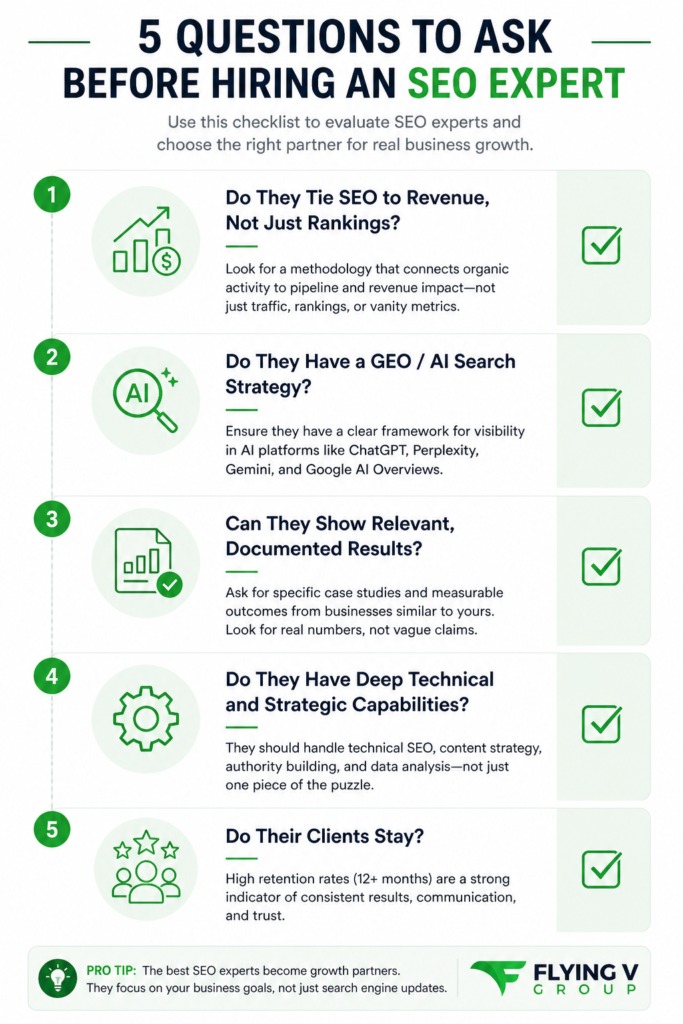
How to Hire the Right Organic SEO Expert: 5 Criteria That Matter
The decision requires a clear-eyed assessment of where your organic program is actually failing, not just which expert has the most impressive deck.
- Does their measurement start with revenue or rankings? Rankings and impressions are inputs. Pipeline and revenue are outputs. Any organic SEO expert worth hiring should map keyword architecture to your revenue model before execution starts. Ask directly: “How do you attribute organic search activity to qualified leads or closed revenue?” Vague answers signal a problem.
- Can they operate across traditional search and AI platforms? In 2026, organic search optimization that ignores ChatGPT, Perplexity, and Google AI Overviews is incomplete. Ask whether the practitioner has a GEO framework and how they measure citation velocity in LLM-driven environments. Most do not. The ones that do are building durable visibility that traditional SEO alone cannot replicate.
- Do their case studies match your business model? A 2,000% traffic increase for a SaaS company does not translate automatically to a professional services firm with a 90-day sales cycle. Look for outcomes that share your revenue model, not just your industry. Relevance of proof beats volume of proof every time.
- What does their technical audit process actually cover? A credible specialist audits Core Web Vitals, crawlability, internal link architecture, schema markup, and content gaps before recommending a strategy. If the first deliverable is a keyword list without a technical foundation, the engagement is starting in the wrong place.
- What does their retention rate look like? Experts with strong results keep clients. Ask for average client tenure. The industry average runs 6 to 9 months. Practitioners like Sean Fulford, where 90%+ of clients stay for more than 12 months, demonstrate through retention what they cannot always show in public case studies.
Frequently Asked Questions
What is an organic SEO expert?
An organic SEO expert improves a website’s visibility in unpaid search results through technical optimization, content strategy, and authority building. Unlike paid search, organic SEO produces returns that compound over time. Rankings earned through strong content and solid technical foundations continue to drive traffic without ongoing ad spend. The best organic SEO experts in 2026 also optimize for AI-driven platforms like Google AI Overviews, ChatGPT, and Perplexity, where a growing share of search behavior now originates. According to SE Ranking’s 2025 AI traffic study, AI referral traffic grew more than 7x year over year, making dual-channel visibility a baseline requirement.
What is GEO, and why does it matter in 2026?
Generative Engine Optimization (GEO) structures content and brand authority so that AI platforms cite your business when responding to high-intent queries in your category. Traditional SEO earns you a ranking. GEO earns you a citation in an AI-generated answer. The two are not interchangeable: a page can rank on page one of Google and never appear in a ChatGPT or Perplexity response, because LLMs index and retrieve content based on entity clarity, structured answers, and attributed sourcing, not keyword density. Practitioners like Sean Fulford have built specific GEO frameworks around citation velocity, query fanout simulation, and LLM discoverability, capabilities most traditional SEO consultants have not developed.
Is organic SEO still worth it in 2026?
Yes, with one important caveat. Traditional organic SEO alone is no longer enough. With AI Overviews reducing click-through rates and roughly 15 to 20% of search behavior now routing through AI platforms, organic search in 2026 requires dual-channel execution: traditional search visibility plus GEO strategies that get your brand cited when AI platforms respond to high-intent queries in your category. The compounding nature of organic search still holds. The difference is that the asset being built now needs to perform in two environments at once.
What should I look for in an organic SEO expert?
Three non-negotiables: revenue attribution capability, GEO readiness, and retention data. On attribution, the specialist should connect keyword strategy directly to your pipeline model, not just report on sessions and rankings. On GEO, they should have a defined framework for earning citations in ChatGPT, Perplexity, and AI Overviews, including how they measure citation velocity and structure content for LLM retrieval. On retention, ask for average client tenure as a proxy for results quality. Beyond that, look for case studies that match your business model and a technical audit process covering Core Web Vitals, crawlability, schema markup, and internal linking before any content or link-building execution begins.
How long does it take to see results from an organic SEO expert?
Initial technical improvements and on-page optimizations typically produce ranking movement within 8 to 12 weeks. Meaningful organic traffic growth from content and authority building generally takes 4 to 6 months to contribute measurably to lead generation. GEO citation visibility in ChatGPT or Perplexity can appear faster when entity signals and structured content are in place, but sustained citation velocity requires consistent content investment over the same 4 to 6 month window. Any consultant promising first-page rankings within 30 days is either targeting low-competition keywords that will not move the needle or misrepresenting what organic search optimization delivers.
How much does organic SEO consulting cost?
Organic SEO consulting typically runs $2,500 to $10,000 per month for small to mid-sized businesses, with enterprise engagements running higher depending on scope and competitive intensity. Independent consultants typically charge $150 to $350 per hour at the senior level. The more relevant question is ROI: a well-executed engagement typically produces a 3 to 5x return within 12 to 18 months when measured against qualified leads, not traffic. The mistake most buyers make is evaluating SEO cost against the monthly retainer rather than against cost per acquired customer, the metric that actually determines whether the channel is working.
What is the difference between organic SEO and paid search?
Paid search delivers immediate visibility but stops the moment ad spend ends. Organic search builds sustainable visibility through technical improvements, content authority, and backlink equity that accumulates over time. The two channels work together: paid search funds short-term lead generation while organic SEO reduces cost per acquisition by building an asset that compounds. An experienced organic SEO expert will help you balance both based on your revenue model and growth stage, and will show you, using LTV:CAC ratios, at what point organic investment becomes the more efficient channel for your specific business.
Sean Fulford’s organic SEO consulting is built for businesses that measure search performance in qualified leads and revenue, not traffic and rankings.
Explore his approach at Flying V Group or reach out to discuss what a revenue-focused engagement looks like for your business.